Search This Blog

Wednesday, March 1, 2017

Cursework and 'Real' Witches


There's a new round of blogs and online commentary about how 'real witches don't hex' going around, spurred it appears by the recent call to hex a public figure and the support and backlash that garnered. The public call for mass hexwork got a lot of attention and the response across social media has been strong, not only about the subject of the hex and whether it's appropriate to hex a political leader, but whether cursework and hexing in general are acceptable to do. Not at all surprisingly there has been a strong thread of disapproval towards the practice and also a very public outcry proclaiming that 'real'* witches don't hex. Period. The end. A variety of arguments are put forth for why 'real' witches don't use baneful magic but generally it boils down to; 1) it's naughty and naughty magic only really hurts the person casting it; 2) hexes don't work anyway; or 3) a 'real' witch is wise enough to know better than to do naughty magic, because vague reasons. 
So let's take a look at this.  
 
I'm not going to speak to whether or not I'm real. I mean I do think a lot which I'm given to understand is one criteria of reality, but for all any of us know we could be a dream within a dream or characters in a story. So let's table the question of reality. I am sure that I'm a witch though, and I do hex. I've talked about it publicly before and I'm not ashamed of it; I don't think it should be done if you aren't willing to own up to doing it. So real or not real, I'm a witch and I hex. I guess that entitles me to an opinion on the subject. I've written about hexing before here and here because its a subject that I feel strongly about. I am not, however, out to convince anyone that they should or should not do it. I believe that it is up to each individual to decide for themselves whether cursework is something they are comfortable doing. What I do want though is to work towards removing the stigma around it that says anyone who hexes is a terrible, morally corrupt person; this is no more or less true than saying a member of the military or a martial artist is inherently violent and dangerous just because they have the skill set to cause harm and an ability to use it if necessary.  


Cursework is a specialty. It requires study just as much as healing or prophecy magic does, and I'd argue that to do it well you have to make it your focus, at least for a time. It isn't something you play with. It has its own rhythms and rules, its own flow and form. It's not for everyone, and not every witch needs to do it, just like anything else. Some people are vegetarians and some are omnivores; some are pacifists and some are fighters; some let energy work itself out and some hex. Different witches have different ethical approaches and beliefs that shape the acceptability of cursework and any kind of magic that  impacts other people's free will. For some people it will always be out of bounds and for others it will be acceptable within certain contexts. I certainly don't know anyone who does serious hexwork who takes it lightly or sees it as a game, for what that's worth. Rather the other people I know who do it approach it very soberly, and often as a last resort when other options have been exhausted. 


Hexing is not inherently dangerous and it isn't a practice that dooms the practitioner to suffer terrible consequences. It is no more or less dangerous to the person doing it than healing is, and just like healing the risk only comes in if the person makes a mistake, which can happen just as easily with blessing magic as baneful magic. I've been at this a long time and I've done more than one hex in my time - and done them knowing exactly what I'm doing and how to do it - and I have never once experienced any negative repercussions on myself, nor has my magic failed to achieve my goal, although it may work faster or slower or stronger than I intended which is exactly why it has to be done with care. This narrative that anyone who hexes will be awash in bad energy, usually described as karma but in the Western sense of instant consequences, is not something I have ever personally seen as true. And I say that as someone who has been practicing witchcraft since the early '90's and admits to hexing, binding, and banishing when necessary. Yes everything we do ultimately affects us but it is far more nuanced and subtle than do good = get equivalent good, do bad = get equivalent bad. And as I like to remind people good and bad are matters of perspective and we must always be careful in judging what is which, especially when it comes to our own actions. 

I've also seen a lot of anti-hex arguments that say that positive magic works but negative does not. By this logic healing spells work, but curses do not, because somehow what helps us and is judged good (remember what I said about judging) is effective but what is judged bad or harmful is seen as impossible or ineffective. It can't be both. Either they both work or neither does. We can't acknowledge the power of one and deny the power of the other, whether or not we ourselves participate in it. To me this just smacks of a way to reassure one's self that good magic works but naughty magic doesn't, as if the Universe only allowed goodness. I think it should be pretty self evident that nothing works that way. I'd also point out as an aside that no type of magic is any more or less addictive than any other, as that has also been mentioned as a reason not to hex. absolute power may corrupt absolutely but this isn't some fictional Dark Side of the Force we're talking about here, where even one slip into practicing it will mean your light saber turning red forever. This is reality, where people are nuanced and complicated and can be good people with functional ethics who still believe its okay to bind a stalker or punish a rapist using magic without plunging into uncontrolled all-Evil-all-the-time-ness.


The third main argument I've seen is that a 'real' witch is wise enough to know better than to hex or curse. Um, in all seriousness why? What exactly is so wrong in hexing or cursing that being 'real' enlightens you so much that you won't do it? Ignoring for a moment the enormous implied insult here that everyone who does hex is not only not a real witch but also unwise or uneducated I genuinely don't understand this argument. I'm impeding someone else's free will. Okay. I'm also impeding their free will when I get a restraining order or use mace to defend myself from a mugger, but I'm going to do both of those things if necessary too, and I don't see how defending myself against someone else's aggression isn't the best course. I suspect this ties back into the assumption that hexing is just done to be mean, but let me tell you something here, the hexing that I've done that falls into the bounds of cursework has usually** been done because I had exhausted all my other options and I was desperate. I or people I cared about were usually in physical danger or other serious situations were occurring that needed an immediate response but for which I had no options.

If you want to argue against hexing then argue against it from a moral standpoint making it clear that you are discussing your own morals or explain your own reasoning for not doing it, but don't use scare tactics that make the practice seem like magical Russian roulette. It isn't. If done with skill and knowledge hexing and cursing are powerful tools and can be useful to achieving goals that otherwise may not be achievable, especially relating to justice and some types of protection. I'm not saying it can't be misused just like anything else, of course, but it can and often is done well and safely for the practitioner. And effectively. And keep in mind that anything is judged good or bad purely based on our own perspective. There's nothing wrong with choosing not to hex because it goes against your own morals or makes you uncomfortable. That's fine. But there's also nothing wrong with deciding that you are morally comfortable with hexing.

 So can we please stop with this divisive 'real witches don't hex' stuff? Yes some 'real' witches do. And some don't. There is no one single type of witchcraft, no single ethic that unites all witches, no agreed on witchcraft code that defines who and what witches are based on what magic they do. What makes a person a real witch isn't whether or not they adhere to one particular moral viewpoint. And cursing and hexing whether anyone likes it or not are deeply ingrained in historic and traditional witchcraft, and in some forms of modern witchcraft as well. If your particular form or tradition of witchcraft doesn't do cursework, that's okay. Don't do it. But that doesn't give you or anyone else the right to dictate what other witches or witchcraft traditions, or other types of pagans who practice magic for that matter, can and cannot do, or should or should not do. Let us stop with the logical fallacies, the 'no true Scotsman' and the appeals to authority and tradition, that are being used to justify condemning anyone who does things differently or who we disagree with. Witchcraft is dazzlingly diverse in its variety and scope of practice. Let's try celebrating that, even when we don't agree with what other people do in their personal traditional magic, rather than condemning and trying to limit other people to conform to our own expectations and comfort zone. 


I am a witch. I hex. And I'm proud of the knowledge and skill it takes to do that well.


*I'm putting real in quotes here to convey sarcasm. I know that doesn't read well online but I can't type real witch in any seriousness.

**usually

Tuesday, February 28, 2017

Pantheacon 2017

  If I had to guess I'd say the biggest pagan conference in America is probably Pantheacon, an event that happens each February in San Jose California. I had attended my first Pantheacon in 2015 and honestly didn't think I'd go to another since traveling to California is a bit of a challenge for me, logistically and financially, but somehow I found myself back there again this year. It will be my one big travel thing for 2017, and the only other event on my schedule is the Morrigan's Call Retreat.


Unlike my first time at this event, this time around there were some notable difference. Firstly although I once again taught a workshop in the ADF hospitality suite I was also on the main schedule with 3 presentations, and I had a book signing. Also unlike the first time I was staying in the Doubletree itself, not in one of the overflow hotels. Both of these things were rather significant changes. I was really happy (and honestly quite surprised) to have had my workshops chosen for the main schedule but teaching a total of 4 classes and having the book signing made for a busy conference. I was also staying in a hospitality suite - East Coast Pagans Hospitality Suite to be exact - and so most of the time when I wasn't teaching something I was there. In practical terms this meant that I didn't have very much time to visit other hospitality suites or get to many workshops.

I did attend one RDNA style ritual in the ADF suite which I really enjoyed. I'd never done anything in that style before and it was very interesting to see the similarities and differences in how it was structured. I've been a member of ADF since 2001 and I always like spending time with other ADF members, especially people I know online but don't see often in real life. It was fun teaching a class on the Irish Gods in their suite, and I liked the questions and discussions that followed. As I could say for many things at the conference, I wish I'd had more time to spend there.

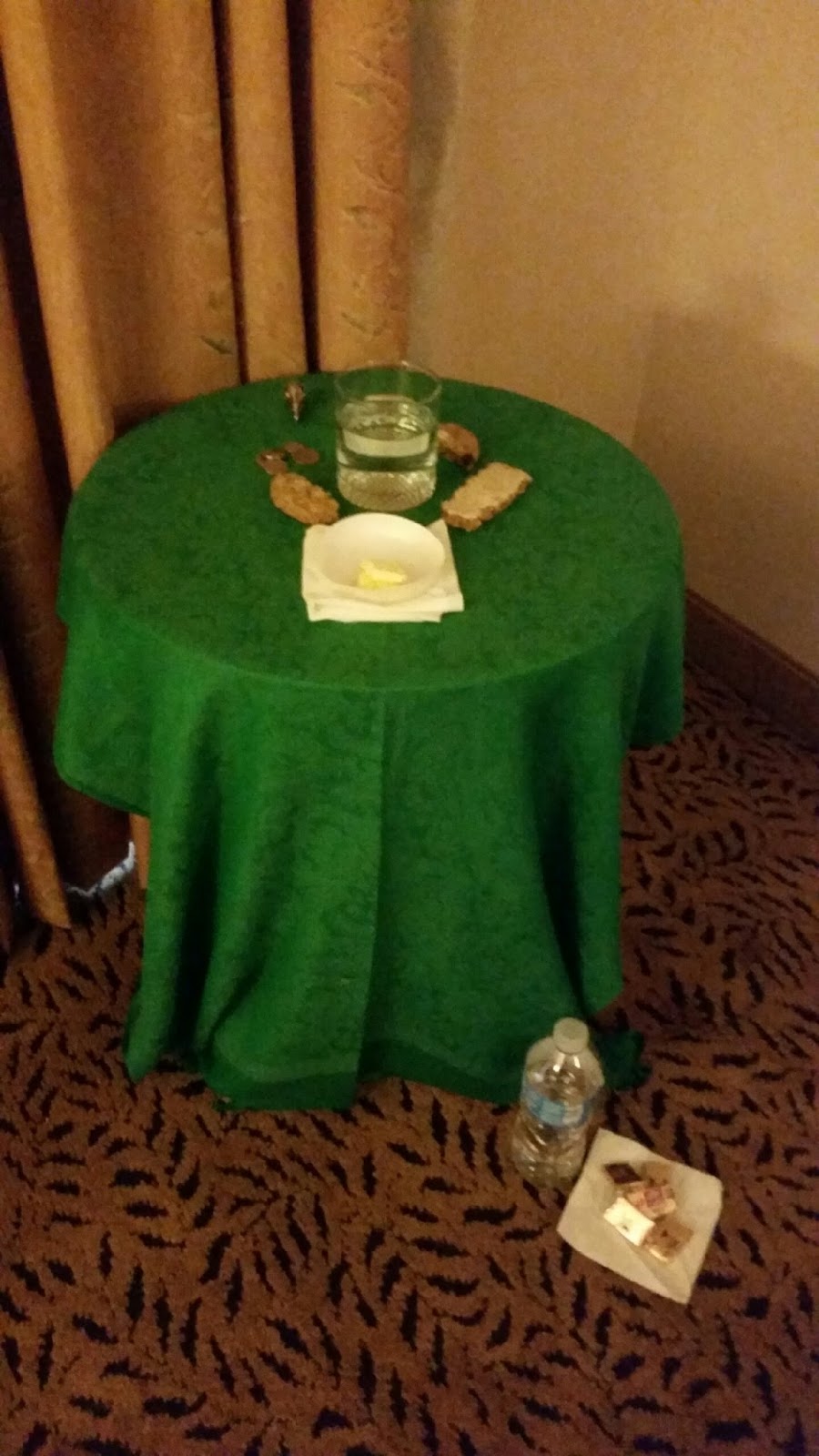
altar for the aos sidhe
My main spiritual contribution in the East Coast Pagans suite was to maintain an altar there for the Otherworldly spirits. Usually when I travel I have some small place set aside for the deities and spirits I honor but I think because this was a space open to the public for 8 hours of the day it required something more elaborate. People were able to leave things on this one, and regular offerings of butter, fruit, and water were being made as well. I quickly made friends with the local crows disposing of the old offerings each morning.

I didn't have much time to socialize but I did find a few moments to get out to some of the other rooms nearby. I was able to visit the Heathen Hospitality suite, which I am so glad I did. I met several Troth members in person who I have only previously known online (having been a Troth member since 2006). They also had some of the best ribbons, in my opinion. Again I wish I'd had more time to spend there, particularly since I have a trip to Iceland coming up in 2018 that several people from that suite are also going on with Land Sea Sky Travel. I was also able to briefly stop into the Sisters of Avalon suite and visit with some familiar faces as well as picking up a very cool new oracle deck.

Pantheacon in general offered a chance to meet some new people, reconnect with friends, and meet people in person I'd previously only known online, which was a wonderful experience. I did find some time, eventually, to have some fun and to hang out with friends, to share stories and to create some new phrases including 'when in doubt cattle raid' and 'no fadas given', although my favorites may have come from my friend Jon of An Scealai Beag who was the source of  such quotes as 'Dagda approves'. One of the best things about the conference, I think, is that so many people attend from so many places and from so many different pagan/polytheist approaches that it allows for a lot of diversity and experiencing new viewpoints, as well as connecting to people from all sorts of different traditions and areas. And of course competitive ribbon collecting.

the beginning of the ribbon collecting

I attended one class which was taught by Lora O'Brien about Medb of Connacht which I highly recommend; Lora also offers the class online here (you may have to scroll down a bit to find it, but its there). Lora had a meet and greet/book signing afterwards and we had some time to talk so there was a bit of crossover between the class and that. I found the ideas brought up really intriguing, including the idea that Medb may have been both a name as well as a title for a priestess at Rathcroghan, and that Medb could have been active in warrior initiation rites. There's speculation in that last of course, but there is certainly a tenuous pattern of male warriors being trained in myth by female warriors* that could indicate a wider socioreligious pattern. Naturally being me I ended up getting a bit speculative about the meanings of Medb's sisters' names and why they may or may not have been fit rulers compared to her based on name etymology. That aside though it was a great class and I'm glad if I only was able to attend one in its entirety it was that one.

My own classes went well, as far as I can judge. The first was meant to be on land spirits and house spirits but ended up being a bit more on land spirits. I did one in the ADF suite, as I mentioned, on the Irish Gods. The second official Pantheacon workshop was on Macha, horses, and sovereignty in Irish culture. And finally I had one on the darker side of Fairy, which was looking at the Unseelie court , who and what they are, and how we interact with them. Turnout seemed good, the audiences were engaged and quick to ask questions, and for the most part we covered all the material I wanted to touch on.

Pantheacon is always an adventure, both the travel to get there and then the experience of being there itself. There are great workshops and diverse hospitality suites, vendors and adventures to be found. As with the first year I attended I think my favorite thing was the experience of community, of being able to spend time with friends I don't see often, or ever, and to relax and discuss everything from theology to linguistics with people who share those interests.


*examples could include Fionn and Cu Chulainn who were both trained by female experts in warfare; more widely in the Ulster cycle we see not only Cu Chulainn but also Ferdiad and Connla similarly trained by women, albeit the same one.

Friday, February 24, 2017

Practicing Safe Hex

Hexing is one of those things that some people feel comfortable doing and others disagree with. This post isn't about the ethics pro or con, but purely offering some safety tips for people who may feel motivated to hex and who are not well versed in the practice. Like any other magical specialty it is a niche practice that requires its own study - in my opinion - to do well. And like most magical specialties if done wrong a person can potentially cause themselves some serious problems.

Black Nightshade
First lets clarify some terms. Technically hex just means to use magic but it's taken on connotations of harm that make it in common usage synonymous with cursing, ie to use magic to inflict harm or punishment on someone. I use the two terms interchangeably in English. In many views both binding and banishing magic falls under the purview of hexing/cursing because they involve forcibly altering another person's freewill. Binding means magically controlling someone's actions, often by limiting what they can do; banishing means sending them away from an area or keeping them away from a person or situation. Hexing in general terms can be a diverse practice that may involve a wide array of methods intended to affect a person in a negative manner, often as a means to achieve justice*.

So, with that in mind some general tips on how to hex safely:

  1. If you are calling on deities of justice or associated with justice, be 100% sure you are innocent in the situation. Generally speaking just because you invoked them doesn't mean they won't weigh your actions as well. Justice is their thing after all.
  2. If you are invoking other types of spirits that historically expect to get paid make sure you pay them something. Most spirits don't work for free, unless you go the route of calling them and binding them to your service which is a whole other conversation. Spirits will help you out but they expect something in return, so offer it to them up front. 
  3. If you invoke, you dismiss. Don't just open that metaphysical door and leave it swinging in the wind. Make sure you show your guests out and close and lock that door when you are done.
  4. Keep your wording consistent. If you are using positive language like 'may he be destroyed, may he lose his prosperity' or whatever then stick with that throughout; if you are using negative language** like 'may she be without rest, may she be without peace' stick with that. Don't mix and match the two, it muddies the waters. 
  5. Keep your intent consistent. Focus matters. Don't try to cram in a variety of goals in a single working, just stick with a single strong intention and be clear on exactly what your intended outcome is. 
  6. Be really clear with your symbolism and know what you are using, what it represents, what its associated with, and any possible deeper layers of meaning that could apply. Don't use foreign symbols or items that you don't understand or know the meaning of. As long as you believe you know what a symbol means or you have a strong association with it that's fine. 
  7. Although there is a lot of historic precedent for using languages you don't speak yourself, I don't personally recommend it. If you don't know what you are saying, don't say it.
  8. Be specific in naming your target.
  9. Do not use your own name especially if you are invoking spirits. This is what magical pseudonyms are for, and no I don't mean your True Name - you guard that like your ATM pin number - I mean that magical name that you share around like free candy. The one that has no real meaning for you. That one. If you don't have one make one up. Think of it as a hexing code name. 
  10. If its a binding be aware you are tying yourself to the person, thing, or situation. Consider whether that's your best option. If its any other type of hex be willing to accept whatever consequence results from it. 
  11. Always cleanse afterwards and double down on your own protections. 


A basic classic hex*** would go along the lines of: "Spirit of ---- I call you to punish (person's name) who has (done X) and caused me (this specific harm). May they suffer (lack of sleep and lack of peace, etc.,) until (item is returned/they are sorry/justice is done/etc.,). In the name of --- I offer (specific offering) let (person's name) be brought to justice."

We also have a wide array of maledictions and satire to look to for examples of traditional hexes in Celtic culture. These usually combine physical actions and spoken charms. Similarly the Norse culture offers an array of cursing options we can look to for examples of how it's done in that tradition. These all help provide guidelines for ways to hex safely.

*historic, mythic, and folkloric examples of hexing often are predicated on attempts to restore social order or avenge harm done to people who have no other recourse. Often, but not always.
**some people prefer to avoid negative phrasing altogether but there is some precedent for it, for example in Irish satire practices.
*** based on curse tablets found in healing springs

Thursday, February 2, 2017

Looking forward at 2017

"Ata la i ndegaid aloile" [A day follows another]
- Etain, Tochmarc Etaine
2016 was in many ways a pivotal year for me, and I think at least some of that was reflected in the content of my blog. I can honestly say that nothing went exactly as I expected it to, and some things happened that I very much didn't expect, but overall I am glad for the place I am in now both with my writing and my spirituality.

 I put my blog on hiatus for the last month in order to finish a manuscript I was working on for a new book. The last blog I posted in 2016 was an excerpt from it and I decided as we moved into 2017 that I needed to focus all my attention on finishing it. I had three books contracted with my publisher, two new Pagan Portals which are by nature shorter texts (25K words each) and the full length Fairies book which I was anticipating would run between 80K and 90K. At the end of last year I was halfway done with the longer book and one of the shorter ones, and I was confident that I could get the longer one finished in a month if I focused exclusively on it.

I'm pleased to say that the Fairies book is done and currently going through copy editing with my publisher. I put everything I knew into it and I learned a lot researching it as well; I think it may be the best thing I've ever written. I still have the two Pagan Portals to write however so I'm not quite ready to hang up my keyboard just yet. I'm hoping that one of those, which I was already about halfway done with, will be completed this month. Additionally I have plans for a sixth novel in my series, although I'm not sure exactly when I'll get to that project.

Now that the longer book is done I should be returning to my regular blogging. I've been working on several translation pieces that should be ready soon so expect to see those coming up this month. I'd like to get back to doing a couple translations or more a month, ideally, and am planning to work through all the Echtrai. I've also had a lot going on in my own spiritual life that I want to share and I'd like to write about topics of interest to people who read this blog. The Fairies book took a lot out of me, more than I expected and more than any other book has before, so right now I'm just looking at what to do to re-set and begin again.

I'm also in the process of making some crucial decisions about exactly where to focus my energy and what venues to use to get my writing out to people. I have this blog of course, and have had it now since July of 2011, but I may look at restructuring or adjusting what I offer here somewhat. I have the books I write, both fiction and non-fiction. I write for Air n-Aithesc twice a year as well as occasionally having articles in other publications - for example I have something in an upcoming issue of Watkins Mind Body Spirit. I'll be speaking at Pantheacon in a few weeks and I'll be back at the Morrigan's Call Retreat again this year in June. Next year I have two sacred sites tours, one in Ireland and one in Iceland. So that's quite a lot going on really. I want to make sure I'm giving my full effort to everything I do.

Tuesday, January 31, 2017

Imbolc – Divination practices

Hawthorn berries under snow, Imbolc 2016


Divination practices are found during all of the significant Irish celebrations and Imbolc is no exception. The timing for taking the omens varied but could occur anytime from the night before Imbolc to the morning of the festival. Particularly the period immediately after the feasting portion of the celebration was often used for divination (Estyn Evans, 1957). In some specific cases relating to the casting of lots for fisherman or the reading of the marks in the ashes the divination occurred on the morning of the festival (Danaher, 1972).

Several Imbolc omens relied on seeing certain animals, and sometimes on noting what the animal was doing. Seeing a hedgehog on Imbolc was believed to be an omen of good weather to come, as it was believed that if the hedgehog sensed bad weather coming in the early spring season he would return to his burrow (Danaher, 1972). This seems to be reflected in the American practice of looking to groundhogs for weather predictions at the same time of year. If you hear a lark singing on Imbolc it is an omen of a good spring (Danaher, 1972). The lark is a bird often associated with Brighid and of good weather.

Weather omens more generally were also very commonly noted. Rain on Imbolc was believed to foreshadow pleasant weather in the coming summer (Danaher, 1972). A windy Imbolc means snow in March, according to this traditional saying:
“As far as the wind shall enter the door
On the Feast Day of Bride,
The snow shall enter the door
On the Feast Day of Patrick.” (Carmichael, 1900, p 173).
By looking then at how the weather is on Imbolc we can foretell what the spring is most likely to look like. I have found it helpful in my own area to keep notes about each feast day's weather and an significant or memorable signs and then what follows or is notable in the next season to form my own ideas about omens, but I have found that a hard Imbolc tends to mean a hard spring and a light Imbolc an easy or early spring.

A ritual for divination involved the use of the slat Brighid, or Brighid’s wand, a peeled stick made of a white wood that was left with an effigy of Brighid near the hearth overnight. The ashes of the fire would be carefully smoothed when the family went to bed and in the morning the marks of the wand appearing in the ashes were a good omen (Carmichael, 1900). An even better omen was the mark of a footprint, seen as a sign that Brighid herself had visited and blessed the home (Carmichael, 1900). Very unlucky though was the home with no mark left in the ashes at all. To turn this ill omen incense is burned through the next night on the fireplace and a chicken is buried alive as an offering at the joining of three streams (Carmichael, 1900).


References
Danaher, K., (1972). The Year in Ireland. Mercier Press.
Estyn Evans, E., (1957). Irish Folk Ways. Routledge & Keegan Paul, ltd.
Carmichael, A., (1900). Carmina Gadelica volume 1, retrieved from http://www.sacred-texts.com/neu/celt/cg1/cg1074.htm

Thursday, December 29, 2016

Fairies and the Dead - An Excerpt from my W.I.P

The following is an excerpt from my forthcoming book 'Fairies: A Guidebook to the Good People'


Fairies and the Dead

The relationship and connection between the fairies and the dead is a complex one, and likely always has been. The human dead aren't fairies, except when they are. Fairies aren't the human dead, except when they might be. The places of the dead belong to the dead, except when those places are fairy mounds, like the neolithic tumuli. Even the Slua Si, whose name means 'fairy host', are sometimes said to consists of the spirits of human dead, as in some cases does the Wild Hunt, making it hard to draw any clear lines between the groups. In a very general sense we can say that human ghosts are not the same as fairies, but fairies can include people who were once human. The key difference may be, as we shall see, how exactly the human came to join the Fey.

Kildare, Ireland

There is some old Celtic belief, recorded by the Greeks and Romans, which hints at the idea of rebirth or reincarnation, that a person born in our world was dying in the Other World and a person who died in this world was born in the Other World. This idea, perhaps, explains the reason that fairies who wed mortal men were known to cry at births and laugh at funerals. It may also explain in some way why the Irish name for the Other World, an Saol Eile, literally means 'the Other Life'. It is not just another world in the sense of being a place, but it is also another life, another type of existence.

There is some suggestion that the initial depiction around the 16th century of fairies as small beings was actually related to the connection between fairies and the dead and the belief that human souls were small in appearance when separated from the physical body (Briggs, 1976). In turn this idea may reflects a related idea, that the soul was separate from the body and could leave it at times, either temporarily or permanently. We see this in the folktales were a person is taken by the fairies but their dead body is left behind and in anecdotes where a person goes into a trancelike state while their spirit is off with the fairies. The idea that the soul can be separated from the body and once separate has a reality and substance that can even be injured is an old one seen in multiple sources (Walsh, 2002). It may be difficult for us to grasp the idea of a soul as a tangible, physical thing when our modern culture tends to prefer the idea of souls as insubstantial and ephemeral but it’s clear that the older belief gave the soul substance.


Fairy tree with rags in a cemetery, Boa Island, Ireland

Another level of entanglement is more straightforward, that is sometimes the Fairies are known to take people to join them and often these people were thought to have died. In a wide array of folklore from Ireland and Wales we see stories where a young woman is thought to die and is buried, only to be seen later among the fairies in one context or another. In at least one story it was a young man who died and was buried, only to have a fairy doctor tell his family that he was among the Other Crowd; when they attempted to retrieve him he appeared and begged to be allowed to stay with the people of the sidhe (Briggs, 1976). The Scottish witch Alison Pearson claimed a dead relative was among the fairies and that it was he who acted as her familiar spirit with them (Wilby, 2005). Getting back to the earlier point about the soul as a tangible presence we must understand that these are people with presence and physicality who were interacted with and who are clearly counted among the ranks of the fairy people.

In the book ‘Fairy Faith in Celtic Countries’ several anecdotes are related that connect the Good People directly to the dead, in both the sense of describing some fairies as being humans who have died as well as saying some of them are people who were taken and thought to have died. One person related a story about a woman who died and shortly after, before the body had been buried, her husband was visited by one of the Good People who told him she wasn’t dead but taken by the fairies; the husband then waited by the body with the door open and his wife came in to see her infant at which time he grabbed her (Evans-Wentz, 1911). After being restrained and struck with a charm he had prepared the wife returned to her body, as the story was related, which revived and she went on to live a long mortal life (Evans-Wentz, 1911). In another tale with a less pleasant ending a bride died at her wedding, only to appear to her new husband later and tell him that she was actually among the fairies and that if he went to a certain place he would see her passing by and could save her (Evans-Wentz, 1911). The husband went as she’d told him to but when he saw his bride among the fairies passing by he found himself paralyzed and unable to move to grab her; he never saw her again after that, but refused to re-marry (Evans-Wentz, 1911). The people interviewed in that section of the book, who were relating the beliefs of different areas of Ireland around the turn of the 20th century, also made it clear that there were fairies who were never human and had never been human, assigning them origins among the Fir Bolg and Tuatha De Danann, as well as saying they were fallen angels. There were also those among the human dead who could and did return as ghosts or other types of undead spirits that were not considered fairies.


The entrance to Newgrange, sometimes called Bru na Si, known as a fairy mound, home of the Gods, and a neolithic burial place


The subject of the fairies and the dead is not a simple one, but it is clear that the two groups are intertwined. There are those beings who were never human spirits and those human spirits who are not and will not be fairies. But there are also those who were once human and are now fairies because the fairies themselves added the human to their ranks. The different layers of belief make it apparent that while there was crossover between fairies and the dead there was also distinction and separation of the two groups in other ways. If one could imagine it as a Venn diagram we would see fairies as one circle, the human dead as another, and the area where the two circles overlapped – how small or large that is no one can say for certain – would represent those who fall into both groups.


References:
Briggs, K., (1976) A Dictionary of Fairies
Evans-Wentz, W., (1911). The Fairy Faith in Celtic Countries
Wilby, E., (2005) Cunningfolk and Familiar Spirits
Walsh, B., (2002) The Secret Commonwealth and the Fairy Belief Complex


All text and images copyright Morgan Daimler

Tuesday, December 27, 2016

Spirituality - Why I Don't Believe in Easy

  The other day I was talking to a friend and I happened to mention that when it comes to spirituality I no longer believe in the concept of easy. Simple, yes, because there are aspects of spirituality and spiritual practice that can be simple. But easy, oh no, easy is one of those things that will trap you into laziness and inattention. More often than not the simplest things are actually the hardest precisely because they require the most attention not to mess up. Something that is complicated or difficult by its nature requires a lot of care to do correctly and so we tend to be less inclined to slack when we do those things. Lighting a candle seems easy doesn't it, but when you are doing it with a spiritual intention you have to always guard against the simple action becoming routine and then losing its purpose and power. After all, what is the difference between lighting a candle for its physical light and lighting a candle for a spell or a prayer, except the focus and intent you put into it?

Do you see what I mean? Easy is a deception. Constant vigilance is necessary to keep simple from becoming ineffectual, and that makes simple very, very hard to do properly.


There are many aspects of pagan spirituality and witchcraft that seem easy. They aren't. And so they are usually the things that are most often neglected or messed up. Shielding. Warding. Cleansing. Offerings. These should all be simple to do, and done regularly, yet too often they fall by the wayside or are not given the attention they deserve.

The difficult thing about having a regular spiritual practice is doing the easy things well when the easy things become routine. Because what is easy is to fall into that sort of mindless action that happens when we've done something so often that the doing becomes automatic. When we light incense regularly in our spiritual practice how quickly do we stop doing it with intention and just light it so we can move on to the next step? When we pour out a bit of drink or give a bit of food as an offering to the spirits [outside of ritual] how quickly does the action become habit and the meaning get lost? doing by rote means doing by reflex without the mind engaged and with things like spirituality and witchcraft that isn't always the best idea. Easy is hard.

As soon as we stop thinking about what we are doing and why we are doing it, we are in trouble. Because like everything else, once we stop thinking about it we stop caring about, stop putting emotion and energy into it. Laziness and lethargy sneak in and it is surprising how quickly we can stop doing the 'easy' things altogether. Stop grounding and centering regularly. Stop shielding constantly. Stop cleansing often. Stop all the basic things that the complex things are built on, without realizing that in the process we are undermining ourselves.

I'm not saying everyone has to take their spirituality to a professional level, of course, there have always been lay people in every religion and its fine if spirituality is a casual concept for you. However even a casual spirituality should be done well if you are going to bother doing it at all. I mean I'm not a professional baker, but if I bake a cake I want to do my best to get the best result and the same should hold true for any endeavor including spirituality. Otherwise why bother at all?

I don't believe in easy anymore. The easier it looks, the harder it will be to do well for any length of time.

Thursday, December 15, 2016

Everyone's Favorite Topic - Fairies, Humans, and Sex

  One of the most consistent threads among the folklore, and one that I've touched on previously is also one that seems to endlessly fascinate modern people: fairies and humans as lovers. While some today like to scoff at the concept as the fodder of lascivious imaginations and trashy novels it is actually an idea that is found and reiterated in mythology and folklore as well as anecdotes into the modern period. As my friend over on the Seo Helrune blog points out in the article 'Elves and Sex' in the medieval period it was common for the Anglo-Saxon word for elf to be glossed with incubus, precisely because of their reputation for sexual interactions with women. Since Seo Helrune covered the Norse and Icelandic material so well on the subject I thought today I'd take a look at the Irish and more widely Celtic.

Probably the oldest examples we have of these stories come from mythology, although I admit it gets murky to delve into this in the Irish were the Gods and the aos sidhe are often only thinly divided. We have the story of Niamh and Oisín, where Niamh is usually described as a woman of Fairy although she can equally be called a Goddess as a daughter of Manannan. Although it involves reincarnation and a Goddess reborn as a human, we also have the story of Midhir and Etain, where Etain is born as a human girl and is courted and won by the fairy King/God Midhir. There is Áine, who we know is a Goddess but is also a fairy Queen, and who is the progenitor of the FitzGeralds; she took the Earl of Desmond as her lover and gave him a son, Geirriod. In a similar vein there is the McCarthy family who are said to be descended from Cliodhna - Goddess and fairy Queen. In the second two stories there are overtones of the sovereignty Goddess marrying a mortal lord to legitimize his rule, but in all the stories we see an Otherworldly being taking a mortal as a lover and in three of the tales having children with them. We could also add the conception of Cu Chulainn to this, although it is a bit more metaphysical in some versions, as we see Lugh - again a God and one of the aos sidhe at this point - coming to Deichtine either in reality or in a dream and fathering Cu Chulainn on her.


'La Belle Dame sans Merci'

Beyond the mythology we also see many examples in older folklore. There were several types of fairies specifically known for seducing mortals, including the aforementioned Leannán Sí as well as her male counterpart the Gean-cánach; these generally did so to the mortal's ultimate detriment. However stories of mortals having sexual relationships with fairies, often producing children, are found across fairylore and with a wide array of types of fairies including kelpies, selkies, aos sidhe, and lake maidens. In the kelpie lore the kelpie can be male or female and while kelpies are more known for tricking and harming people in these cases the kelpie falls in love with the mortal and seduces them. Sometimes the mortal awakes after a tryst and sees their sleeping lover only to notice the telltale bit of water-weed in their hair, or dripping water, or other give-away sign that reveals their nature and the mortal flees. Other times the two wed and only after a child is born does the mortal realize their spouse's true nature and leave; although their is one iteration of the story where a male kelpie captures and imprisons a mortal girl as his 'wife' and she escapes after a year, usually leaving behind a son. In the selkies tales the male selkie woos the mortal girl to his home under the waves, while the female is only taken as a bride to a mortal - in the stories - if her sealskin coat is taken from her. Again however children are the usual result of the marriage. You can see the pattern here. The aos sidhe stories appear under a variety of forms usually with the human being kidnapped or taken into Fairy, sometimes willingly sometimes not. The lake maidens of Wales usually are willing wives but come with geasa, and once those taboos are broken they immediately leave, like the selkie bride finding her sealskin, returning to the waters they came from. 


Some versions of the story of the MacLeod Fairy Flag say it was a gift to the family from a fairy lover who had born a MacLeod child. One of the most widespread stories found in fairylore across different Celtic cultures is that of the borrowed midwife who anoints the baby's eyes and accidently touches her own, only to be granted true sight and realize that she has delivered the half-fairy child of a local girl*. This girl has been taken into Fairy as the wife of one of its inhabitants and obviously just proven that humans and fairies are in fact cross-fertile. Which shouldn't be surprising since one of the leading theories about changelings is that fairies steal people to supplement their own population, and that doesn't exactly mean the people become fairies so much as it means the people make more fairies, as the midwife tales illustrate. The gender-flip version of this story might be the Ballad of Tam Lin although Tam Lin is more properly a Changeling as opposed to being a true fairy himself; in the story however the mortal girl, Janet, does not know that until after she's taken him for her lover and conceived his child. Only when she goes to the well he guards to gather herbs to abort the pregnancy and Tam Lin appears to stop her does she question whether he was ever human**. Many of the Scottish witches who confessed to dealing with the fairies also admitted having sexual relations with them, as opposed to the more usual demonic intercourse other witches admitted to. At least one 19th century Bean Feasa was known to have had a fairy lover as well.

In the book 'The Good People', which is an anthology of collected articles about fairies there are several discussions of more modern anecdotes. These come from interviews with people in Ireland, Wales, and Scotland conducted in the 20th century and looking at modern fairy beliefs. It is, in its own way, the next generation of Evans-Wentz's 'Fairy Faith in Celtic Countries' and it includes some discussion of fairy lovers and of the children born of these unions. Generally to have a fairy lover carried prohibitions (geasa) often of silence about their existence but sometimes it might be something like not striking the spouse three times. With the selkies, who were unwilling brides, the magical sealskin must be hidden, and in Welsh lore a fairy wife was often secured by learning her True Name which had power over her. The children of these unions were known to be uncanny and in many stories were taken into Fairy by their Otherworldly parent; those who remained in our world generally stood out as odd or unusual in their mannerisms and preferences; like their fairy parent they tended to behave in ways that seemed to defy human mores or etiquette as often as not. Children born with selkie heritage were said to long for the sea and often to have webbed hands or feet, as well as dark hair and eyes. 

So, we can see that there's a long established pattern of fairies taking human lovers. Sometimes only as lovers, sometimes as spouses, sometimes producing children, sometimes not. Usually the human half of this equation is someone who has broken social boundaries by seeking the fairies out, such as we see in stories of woman going to do their work in places known to belong to Themselves or going to wells known to be Theirs, or of people who are in a liminal state, for example about to be married. Keep in mind as well this wasn't, for the most part, figurative or imagined - not 'on the astral' as some people might say - but occured in the physical, tangible world. Other people reported seeing these beings in some cases and the resulting children were real, physical children. Usually when the person was taken into Fairy they were thought to have died, which in the parlance of Fairy means they may have actually died in our world. Give that some thought. 

Before you go rushing out to find a fairy lover of your own it is worth considering that as often as not these things end badly. And by badly I mean with the death of the mortal partner, sometimes through mischance and sometimes through violence. In other stories the mortal violates a taboo - a geis - set down by the fairy partner and loses them forever, which generally drives the mortal mad. So this whole concept is a bit more dangerous than your average Tinder hook-up, and shouldn't be treated lightly. 

*in different versions the girl was either thought to be dead, missing, or known to be taken by fairies. In all versions the midwife later sees the husband at a fair and he puts out her eye when he realizes she can see him.
**Oh Janet, really? Seems like the sort of question you might have wanted to ask a smidge earlier, if it mattered. Like before you lifted your skirt.

Further Reading:
Briggs, K., (1976). A Dictionary of Fairies
Briggs, K., (1967). The Fairies in Tradition and Literature

Silver, C., (1999). Strange and Secret Peoples: Fairies and Victorian Consciousness
Purkiss, D., (2000). At The Bottom of the Garden: A Dark History of Fairies, Hobgoblins, and Other Troublesome Things
Narvez, P., (1999) The Good People

Friday, December 9, 2016

7 Snarky But Serious Tips for Dealing with Fairies

Inspired by the always awesome Seo Helrune blog and today's 'Eight Sarcastic But Serious Tips for Necromancy'. I give you 7 snarky but Serious Tips for Dealing with Fairies


Since fairies are pretty trendy right now and people are paying mad money to become a certified Fairyologist - or Fairy Doctor, or Fairyist, or whatever today's popular term is - I thought I'd save everyone some money and offer this free down and dirty guide to fairy work. Think of it like the Cliff Notes version to years of actual experience, study, and effort.

Why Work with Fairies? - You like to live dangerously, right? Not afraid to risk some maiming or madness or inconvenient death? Good. There are advantages to trucking with uncanny things of course or no one would do it, but I just wanted to get that bit out of the way right out of the gate. Now that we've established that you have a healthy disregard for your own sanity and safety I'll point out that those who successfully navigate dealing with the Fair Folk are usually rewarded with knowledge, luck and health. And rumor has it wealth. So there are benefits to establishing a good relationship with Otherworldly beings, and those benefits can be very valuable and even tangible. Of course you aren't allowed to talk about any of that, so should you manage to score some super secret fairy bennies just remember to keep your mouth shut about it, or, well I already mentioned the maiming and madness part right? Another benefit of working with fairies is that odds are good you'll either be given or learn to make elfshot, and who doesn't want to have an invisible means of getting even with your enemies? None of this is free, of course, but don't let little details like that bother you.

Convenience - The great thing about fairy work is that pretty much every culture has fairies, by one name or another, and so no matter where you are you'll be able to find Otherworldly spirits. A smart person would do some research and look into local folklore and stories, but if you really do like to live dangerously just jump right in and see what happens. Best case scenario it'll be fine. Worst case scenario, well, reincarnation is a thing right? Or you could do the research. Dealer's choice.

So, let's get to it then. Here's some tips.

1. Start Small - no pun intended on this one, but if you want to deal with the Fey going right to the ones most likely to eat you for dinner or to turn you into something unnatural probably isn't the best idea. Start small. Like really small. I mean, sure, in stories people like the Brahan Seer or Turlough O'Carolan slept on a fairy mound and were rewarded with amazing abilities, but there's also all those jerks who tried the same thing and went mad for the effort. The thing about fairies is that some can and will help you and bless you in awesome ways - and some can and will torment you and laugh while they do it. Also some think you are a mighty yummy appetizer. So if you begin with something like your house spirit who is already inclined to like you and build a relationship there, you can get the practice in before you move on to bigger things. Although keep in mind your house spirit can also seriously jack you up, so don't slack off just because I said it was a good place to start. Also keep in mind I'm saying 'start' not end - the idea is to slowly build up a network of friends and allies in the Otherworld. Just don't aim above your means right out of the gate.

2. Bribe Them - some people are really against the whole concept of bribing spirits. I suspect these people don't deal with many spirits. Remember how I mentioned that nothing is free? Yeah, funny thing about that is if you don't offer something in payment up front sometimes they'll decide to set the price themselves later on. You do not want this. No one wants this. Being in unspecified debt to a member of fairy is kind of like owing a favor to the mob so you are much better off to go into any dealings with Them paying upfront. I recommend butter or cream, but I'm a bit of a traditionalist. I'd avoid offering blood - your own anyway - or anything else with heavy metaphysical implications for you.

3. Negotiate - Speaking of payments you may find yourself in a situation where you are being offered something you really, really need in exchange for something else. Like your firstborn - what you thought Rumplestilskin invented that idea? Fairies taking babies is an old practice and its a lot easier if one of the parents gives them up willingly. Not all changelings were stolen, some were bargained away, and if you think I'm kidding then please, please, don't try to deal with fairies. No, really. Don't. They may ask for something else but whatever it is you should be asking yourself why they want it and whether you really want to give it up. I mean a soul seems pretty inconsequential until you don't have yours anymore. So don't be afraid to negotiate or even to say no. Sometimes it's just not worth it. Did I mention the butter and cream?


4. Manners are a Thing -  Seriously though, if you want to deal safely with the Good People then you better say 'please' and 'May I?' like you are visiting your Grandmother. And not the nice one who bakes you cookies but the strict one who doesn't let anyone slouch and has plastic on the furniture so you rotten kids won't get it dirty. Although there is a prohibition against saying 'thank you' which many people I know agree is best to follow; say something else instead which isn't 'thanks'. Why no thank you? Some people say it is dismissive, while others say that it is an admission of a debt - see point #2 for why that's bad if you've already forgotten. The key here is be on your best behavior, be polite, and remember that you aren't the one with the actual power here. Which is why you are dealing with them in the first place right?

5. Keep It Clean - I don't know if cleanliness really is next to godliness or not but I do know that the Fair Folk detest filth. You want to know a really good way to ensure that the Good People will be against you? Pee on land that is theirs. True story. A traditional method to keep them out of your home involved dirty water, and it was an old practice to always yell 'Beware' before tossing dirty water out a door or window after cleaning, because you did not want to hit a fairy with that water, should one be passing by. So if you want to work with fairies keep it clean.

6. Don't be an Ass - I suppose I could have put this under #4 but honestly its such a big issue it deserves its own bullet point. I don't know why people labor under this delusion that getting a huge attitude and treating the Good Neighbors like you are some spoiled prima donna and they are your lowly intern is a thing, but it does seem to be a thing so here we are. I have seen popular pagan authors suggesting people make their own fairy* or command fairies to certain tasks and that is just a jerk thing to do. Fairies are independent, sentient beings. Would you walk up to a stranger in the street and start bossing them around? Unless the fairy starts it first and you are being a jerk in defense of yourself or similar, just don't go there. You go there and so will they and that is not a contest you want to get into unless you are 100% confident you will win - and they have a lot more experience at it. Also way more viciousness. So for the love of all that's green and growing don't be an ass unless and until you have to.

7. Speaking of Asses Always Cover Yours - The best laid plans still go sideways so always have a worst case scenario plan in mind. Know what protections work against which fairies - because there is no one size fits all - and know when to bluff and when to run. Have an escape plan behind your back-up plan. And know exactly how far you are willing to go and what you are willing to do. I mean when it comes down to it would you kill something? Would you maim something? Remember tip #6? Well I mentioned don't be a jerk unless you have to but understand if you have to go there you have to go all the way there. You can't half-ass your jerk attitude with the fairies when that attitude is required by a situation. Which by the way is exactly why you don't want to lead off with it, because if you are going full-ass jerk then you'll be wearing iron jewelry and lighting up St. John's Wort and sulfur every day for a loooooong time. This is also why tip #1 is to start small and build up relationships, because if the shit hits the fan you'll need those allies.

So there you go.
Good luck. You'll need it.

*in fairness while they called it a fairy they were actually talking about making a thoughtform or golem. But still the principle of creating your own fairy servant is pretty offensive so here we are.

Thursday, December 8, 2016

My Shifting Spirituality and Fairytale Wolves

I've been thinking a lot about wolves lately. I'm in a place spiritually right now that is a bit contradictory - several events in Ireland were very empowering and intense for me and moved me into a deeper connection with the Other Crowd, but at the same time other things have become chaotic as a result. Not all of this chaos was predictable and the wolves are a good example of that. I have a long (like almost 30 years long) running relationship with birds as spiritually significant and I'm not saying that is gone necessarily but it has certainly changed. And I have never resonated with wolves before so that is an entirely new and somewhat strange feeling, yet I am being strongly drawn to them. So I began exploring what wolves symbolize to me and I started with fairytales, a subject I'd already been thinking about; the intersection of the two subjects became something of an epiphany which I'm going to try to convey here as best I can.

 Fairy tales were - if you'll forgive the expression - my bread and butter growing up; I read and re-read Grimm and watched every available Disney movie. Yeah, I was that kid. And as I got older and segued more into the older folklore and folk stories the children's fairy tales kept a place in my heart, although I was cynical enough to see the less appealing patterns in them. The princess with the tragic backstory who needed saving, or else the peasant girl with the same; in both cases the girl was almost always helpless and victimized and just waiting around for the right guy to save her and give her the perfect easy life. (Not a concept that especially appealed to me, by the way, as I always felt that the only one who was going to save me was myself). And of course there was usually the prince or sometimes a woodsman who was the hero*, rushing in at the eleventh hour to save the girl just in time. The antagonist was generally someone with inherent power in the girl's life, be that an evil queen, a step-mother, a witch, or an evil fairy - usually female by the way, because the girl's father generally died or stood by and did nothing to help her - and this antagonist was motivated more often than not by base jealousy. Not exactly the most engaging pattern once you start to see it and it did take some of the luster out of the tales for me, and that was before I got a hold of the original versions of the stories, where there mostly weren't any happy endings, just a lot of misery and retribution**.

In a few stories there is another character though - the wolf. We all know the fairytale wolf of course, the chilling howl in the night, the glowing eyes by the side of the path, the calculating predator that will try to talk you into your own destruction. The wolf, usually labeled the Big Bad Wolf, is a different kind of antagonist. The wolf isn't jealous or vengeful. The wolf isn't motivated by anger or by ambition or lust***. The wolf, you see, is simply hungry and is doing what wolves do to solve that problem and of course in the stories the wolf is anthropomorphized and so uses cleverness and guile to achieve their ends instead of simply attacking the protagonist. The wolf is the archetypal predator and in fairy tales that archetype deepens into that of the antagonist who is truly frightening precisely because they aren't motivated by human emotions, but by simple physical hunger. The wolf schemes to trick the young goats in the story of 'The Wolf and the Seven Young Kids' and Red Riding Hood in 'Little Red riding Hood' with a frightening deviousness that seems difficult to avoid. In fact in both stories the protagonists are only saved after they've been eaten, when a Hero comes along and cuts the sleeping wolf open to rescue them. Which, by the way, doesn't kill the wolf - rather the sleeping wolf is filled with stones and later wakes without realizing what's happened and usually goes to drink and falls into the river and drowns. But is the wolf really trying to kill anyone, or is the wolf teaching the other characters a lesson^? In all the stories the wolf succeeds in tricking the others and consuming them, yet in most they emerge safe - if shaken and wiser - at the end. The wolf may be a harsh teacher, but they are a ultimately a teacher in the stories: about the dangers of not listening to good advice, about the risk of letting in wolves, of the difference between safety and danger. There's some interesting layers of Fairy in there to me, of the supernatural wolf who can consume animals and people without killing them and who can't be killed even by a blade but must instead be killed by earth and water and trickery.

Little Red Riding Hood, by Gustave Dore (d. 1883) 
As I've been rethinking fairy tales, I've been re-thinking where I see myself in them. I am definitely no princess waiting helplessly for someone to come along and save me.  I'm no prince who needs a princess to save - really I just don't see myself in any way as one part of an equation that needs another person to be complete. And I'm not a woodsman or hunter with a sharp ax and a no other purpose but to pop up when a wolf needs cutting open. I've never liked fairytale witches with their mindless evil but I do like evil queens quite a lot as it happens; I admire the way they defied societal conventions to be women with real power in their worlds, but I dislike the random jealousy or paranoia-motivated homicide. But as I've been contemplating the wolf in stories I've found that I do connect to that concept. They are certainly forces of chaos and they seem to defy the whole idea of a clear-cut bad guy because they are just doing what wolves do and trying to get a meal (as opposed to overthrowing a kingdom or your standard step-child murder over jealousy) and excluding interpretive Victorian sexual innuendo they are non-sexual. And in most of the tales the wolf is also playing the role of teacher, giving harsh if memorable lessons to the others. I really resonate with that. They are the one character in the old fairy tales who isn't a victim with a tragic backstory who needs saving or a jerk with a sword who needs someone to save, or the villain driven by jealousy, or traditionally evil like the witches, etc., There's a purity in the danger the wolf represents and in the lessons they teach, as well as the beautiful contradiction of the way they reinforce the need for civilization and solid walls while they themselves live wild and untamed in the trackless woods.
I really admire that story line.

I began my wolf-quest with fairytale wolves and this re-assessment of their role, and from here (probably in future blogs) I will look at wolves in Irish folklore and wolves as they relate to witches, the Good People, and the Gods. These are all heavy, complex subjects and its a lot to unravel. Wolves relate to both the Morrigan and Odin, two deities I am strongly bound to, for one thing and I know there is a lot of material there to process. There is also a great deal of Irish so-called werewolf lore to get through. And on a purely personal level there is the spiritual, experiential side of things. For now, there's this poem I wrote as I meditated on the connection I feel with the fairytale wolf:

I am the Wolf ~ a poem
"You see I am the wolf -
no red clad, hooded maiden,
no ax wielding woodsman,
my role in this fairytale is
neither lost nor saving
but hunting and howling
running wild off the path
and sleeping sated in
your warm comfy bed.
That's the thing about wolves
we like our solitude but
we run in packs too
when it suits our mood.
And I am as much sharp
teeth and terrible claws
as I am soft, warm fur
and endless loyalty.
I am all of that and more,
enchantment and fierceness
Magic and menace.
You see I am the wolf
And in my story
the wolf always wins."
- M Daimler 2016


*There are some exceptions to these of course, like Hansel and Gretel were Gretel is the hero who saves her brother by shoving the witch into the oven. I'm speaking in general terms here.
**In most of the older versions for example 'consent' isn't really a thing, and the princess being conscious isn't even a requirement so in several versions of Sleeping Beauty she conceives twins while still under the curse. So much for that awoken by a kiss bit. In the older Cinderella after she marries the prince she forces her stepmother to dance to death, and in the original Little Mermaid Ariel fails to get the prince and becomes a wind spirit - and so on.
***I know a lot of later commentators do try to make everything in fairy tales into analogies for sex, including the wolves, but I suspect this is more a reflection on the culture of that time than the actual story. For a person who had no real wolves howling in the night to fear it might make sense to see the wolf as a symbol of lust or sex, but for the people first telling the tales who shivered at the sound of wolves in the darkness I think they meant the wolf to be a real wolf. To them the wolf was an animal who did lurk in the woods and who would eat little goats and pigs and even maybe naughty little girls who wander off the path into the trees.
^In the oldest version of Little Red Riding Hood the story ends with both Grandmother and Red being eaten and never rescued, but I'd still argue in that case the lesson is being taught to the reader, albeit with a far grimmer tone. I did say before that the original versions didn't have happy endings. 

Friday, December 2, 2016

Quick Thoughts on Apotropaic Iron

there seems to be a lot of confusion about the apotropaic qualities of iron.
So, let's clear some points up.
Iron is said in folklore to protect against a wide range of spirits and negative magics including [most of] the Good Neighbors and Alfar, Ghosts, Demons, and witches. Iron objects deter the majority of the Other Crowd who are averse to its presence and things like knives, scissors, nails, and horseshoes were recommended as protective objects. It is said that cemeteries had iron fences to contain any ghosts inside. Similarly older folklore said that demons were also repelled by iron, and it was believed to break the magic of witches. A horseshoe hung up above a doorway kept out a wide range of spirits as well as protecting from baneful magic.
Many people are familiar with the term 'cold iron' and associate it today with pure or simply worked forged iron - what is technically called 'pig iron' or 'crude iron'. Historically the term cold iron was a poetic term for any iron weapon and is synonymous today with the term 'cold steel'. So when you see a reference to cold iron it is talking about an iron weapon, usually a sword or knife.
As to iron and steel - they are effectively the same substance and have been treated that way in folklore and for apotropaic purposes historically. Steel is between 90 and 98% iron depending on the alloy, so a steel object is obviously mostly an iron object.
Those who are seeking to encourage the presence of the Gentry should remember their dislike of iron and limit its presence. On the other hand those seeking protection from Otherworldly influence would do well to keep iron or steel objects around. Remember though that I said earlier it is a protection against *most of* the Good Neighbors. In folklore there are some Fae it is known to have no effect on, including Etins, Redcaps, and spirits associated with mines or forges. Other protections are required for those, like salt or silver.


*editing to add:
in my experience iron ore and stones with high iron content work the same as iron, but to a weaker degree, ie hematite which is about 70-ish% iron and magnetite (72% iron) both work to deflect negative magic and to deter ghosts, negative spirits, and the Fey who are sensitive to iron but not as intensely as worked iron (even so-called 'pig iron'). 
Iron ore is most often hematite or magnetite along with a few others with a slightly lower iron content so it makes sense that they work in a similar fashion to iron. A variety of crystals also have iron as a component which is what give them their color, such as peridot, but usually not in an amount that would act as an effective deterrent (although I think its unlikely any Fey would wear them or desire to be around them and if you offer crystals to the Other Crowd I might suggest looking for ones without iron content)


- M. Daimler, 2016


Tuesday, November 29, 2016

The Doubled Edge of Fairywork

Sometimes people ask me why I don't talk much about personal practice and experience with the Othercrowd, beyond a handful of anecdotes that I repeat and some fairly generic for-public-consumption stories. I'm pretty free with talking about experiences that occured with other people, about being pixy-led, or seeing fairy hounds, or items being taken and returned. And I will talk about the numinous, about the Gods even the liminal Gods, pretty easily. So why not share more of the deeper personal things?


It's a hard thing to talk about for many reasons. Certainly one is that I worry about people questioning my sanity as I talk about these experiences. Its funny how we can talk about things with Gods and people are, if not supportive, at least more willing to consider possibilities; even ghosts are met with a basic assumption of the person's sanity. But when it comes to the Othercrowd, at least in my experience, people are far quicker to jump to 'crazy' to explain away something. And of course I worry that in speaking about it I'll say too much and lose their favor which is a concern supported by folklore - the quote may go that the 'first rule of fight club is don't talk about fight club' but in my experience that is far more applicable to fairies. There's also always the worry that people simply won't believe me because its so difficult to convey these experiences in words without making them sound trite and contrived. Even I don't think some of them sound believable when I tell them, and I was there when they happened. So there's the fear that people just won't believe what I'm saying is true.

And there's the worry that they will.

I feel often like I am talking out of both sides of my mouth, saying on one side to seek Themselves out for their blessings and friendship and on the other to avoid them because of their mercurial nature and danger. And the Heaven and Hell of it, if you'll pardon the expression, is that both are equally true. Because I do think there's value in keeping the old ways and the reciprocal relationship with the Good Folk that has existed for many hundreds, if not thousands, of years - and indeed part of my service to Them as a priestess is to do what I can to keep those old beliefs and traditions viable - and I think that people should be encouraged to do that. But I also think that modern pop-culture has done the Fairy Faith no favors and that people do need to be reminded of the respect and fear that They are due and why they are due it. So its seek Them out and encourage Their interest in you but at the same time be cautious of Them and don't get Them too interested. And if that's a contradiction, then consider it your first lesson in fairywork.

I talk a lot about the darker side of Fairy and the dangers of the beings who dwell within it, and I do that on purpose. The Otherworld and its inhabitants are not the stuff of young adults novels and LOTR fanfiction. I see too many people who plunge head first into seeking the Gentry out, heedless of any potential danger, and my instinct is to warn people. I'll use the analogy of hiking here, that hiking on a summer day seems really appealing because its so beautiful and looks so easy - you just start walking in the woods, isn't that nice? And you know most of the time it will just be nice and pleasant and nothing bad will happen. Nothing at all will happen except for you getting some exercise. But - oh, there's always a but isn't there? - anyone who is an experienced hiker knows that there's always a chance of getting lost, or falling and getting hurt, or being attacked by an animal, or eating something that looks familiar but isn't what you thought it was, or...or. You see? And that's what I might say that Fairy is like. And if you get lost or hurt or attacked you had really better know what to do about it.

And there's a part of me that doesn't like to talk about some things I've seen or experienced because I worry that it may give people the wrong idea, may make things seem more alluring or good than they actually are. May make people forget the danger. May create that urge in people where they want to have that same experience because they are hearing the beautiful experience and not grasping the fuller context.

I am not yet 40 years old and I have seen things that I will never stop seeing - not horrible, terrifying things either but things so beautiful it breaks the heart and so enchanting it makes everything in mortal life seem a pale shadow in comparison. Beauty is a poison in its own way, and it sinks into the bone beyond removing. The stories talk about that too but we don't want to see it most of the time because we like the idea that people can be saved from Fairy in the end and return to their lives and be happy here. But once you've heard that music and once you've seen those shining halls you lose a part of yourself to the sound and sight of it and there is no real coming back from that. The old stories talk about that too you know. And ultimately I don't want the responsibility of leading someone else where I am, aching for a world that isn't here and that nothing here compares to.

Fairywork is worth doing and it has benefits that make it worth the risk, like any other dangerous thing. But it is dangerous both in Fairy's ability to actually harm a person and the way its enchantment changes a person. It is something that must be done with care and with constant vigilance to be done well, or something that must be done lightly to be done safely, or something that can and will consume a person. I suppose I talk about the things I do because I'd rather be a horrible warning than a great example, to paraphrase Aird,.

And so when I talk about it I try to talk enough to encourage people to want to do it, but not enough about my personal deep experiences to give the impression that losing your soul to it should be a life goal. And I try to emphasize the danger so that if things go sideways people can't say they didn't know the pitfalls and bears where there along the trail the whole time.