Search This Blog

Thursday, February 14, 2013

Thoughts on Boudicca and Hero-cults

"When the going gets tough, the tough channel Boudicca" - T-shirt wisdom
  If you ask me who my favorite historic person is, or which one person in history I'd like to meet, I would answer Boudicca. Ever since I first heard her story I have had a strong affinity for Queen Boudicca and I have adopted the above motto, which I first saw on a t-shirt, as my own approach to difficult times. For those who are unfamiliar with her, Boudicca (alernately Boudica or Boadicea) was the Queen of the Iceni tribe in Britain until 61 CE. Described as a noblewoman, tall, with reddish brown hair and keen inteligence; she was said to wear a multicolored tunic and a golden torc. Her husband, King Prasutagus, had allied with the occupying Romans and had written a will that left his kingdom to his two daughters and the Roman emperor, jointly. He had hoped by doing this to keep his people nominally independent of Rome and to maintain the status quo that existed during his life, however Rome did not acknowledge a woman's right to rule and after his death his will was ignored. The Roman forces took over the Iceni; Boudicca was publicly flogged and her two young daughters were raped. In response to this double outrage Boudicca rallied the Iceni and several neighboring tribes and rebelled against Rome. Boudicca was said to be devoted to the goddess Andraste and as a form of divination before battle she released a hare and watched the way it ran. She succeeded in driving the Romans into retreat and burned several major cities to the ground - including what is now Colchester and London - pursuing the Romans south. Despite these early successes the Romans eventually rallied and met the much larger force of the rebelling Britons.
   Before the final battle Tacitus tells us that Boudicca addressed her gathered forces, saying:
    "This is not the first time that the Britons have been led to battle by a woman. But now she did not come to boast the pride of a long line of ancestry, nor even to recover her kingdom and the plundered wealth of her family. She took the field, like the meanest among them, to assert the cause of public liberty, and to seek revenge for her body seamed with ignominious stripes, and her two daughters infamously ravished. From the pride and arrogance of the Romans nothing is sacred; all are subject to violation; the old endure the scourge, and the virgins are deflowered. But the vindictive gods are now at hand. A Roman legion dared to face the warlike Britons: with their lives they paid for their rashness; those who survived the carnage of that day, lie poorly hid behind their entrenchments, meditating nothing but how to save themselves by an ignominious flight. From the din of preparation, and the shouts of the British army, the Romans, even now, shrink back with terror. What will be their case when the assault begins? Look round, and view your numbers. Behold the proud display of warlike spirits, and consider the motives for which we draw the avenging sword. On this spot we must either conquer, or die with glory. There is no alternative. Though a woman, my resolution is fixed: the men, if they please, may survive with infamy, and live in bondage." - Tacitus, The Annals Book XIV
   Now whether Boudicca actually said any of that or whether it is purely Tacitus's creative idea of what she said, I do not know, but the words certainly resonate and seem to sum up her story, and the Celtic spirit itself. Unfortunately for Boudicca and her people the Romans emerged victorious from the battle and the rebellion was put down. Boudicca herself died shortly after the fight, either from illness or suicide. Her daughters are lost to history, but it is most likely, I think, that they died after the battle.
   It is her fighting spirit that draws me and her willingness to fight for her family and people against the odds. I respect her for being a leader when it would have been easier back down. To me Boudicca is an example of a female historic figure who fought for freedom and for justice and who embodies strength of will. And, of course, I love that she almost drove the Romans from Briton.
   For a little while now - perhaps the last year - I have felt called to honor Boudicca more actively. This feeling has had me contemplating the Greek and Roman idea of the Hero-cult, that is the honoring of historic or mythic heroes as Powers above humans but beneath the Gods. This idea grew out of the older ancestor worship of these cultures and marked a shift from honoring relatives within a family to honoring heroes within a community. I have been thinking about it since I first heard of some people who are celebrating March 17th in honor of Cu Chulainn, after the fashion of a modern hero-cult. The idea of taking a Celtic approach to Greek hero-cults appeals to me very much, but I have no strong draw to Cu Chulainn; on the other hand the idea is perfect as a way to honor Boudicca. 
   Now I admit my understanding of the concept of hero-cults is fairly basic, and so my take on the Celtic version of a hero-cult to Boudicca is as much guess and adaptation as anything resembling historic practice. For one thing, as I understand it, hero-cults usually centered on sites associated with the hero or on relics from the hero, neither of which are options for me since I don't live near Norfolk (England) or have anything directly associated with Boudicca herself. The best I can manage is an artist's rendering of Boudicca, which is itself someone's best guess based on descriptions of what she looked like. I created a small hero shrine to her on my ancestor altar, nonetheless, by placing a candle in front of a ceramic bowl filled with earth from different sacred sites, her image, a goddess-figure representing Andraste, and several branches of a pussy-willow tree (representing - to me - hope and survival). Several times a week I sit before the little shrine and burn the candle, offering some incense, and contemplate the qualities of Boudicca that I respect and how to nurture those same qualities within myself. 
  I have only just started on the tentative path of honoring Boudicca, and I still have several details that are unresolved. I would like to have a special day to honor her, rather as modern Heathens do for several historic Heathens of special note such as Sigrid "the Haughty" or Ragnar Lodbrok, but I haven't decided which day is best yet. Another aspect of the traditional hero-cult that I have not yet worked out in my own practice is the idea of the hero communicating with devotees using signs and omens at the site of their shrine; obviously my little shrine isn't easily adapted for this. I would like to include the use of hares or rabbits for divination/communication perhaps by working up my own system using bones or perhaps by adapting an existing system. Even though there are still details left to deal with, I feel very positive about beginning to honor Queen Boudicca and am confident that I am slowly moving in the right direction.


Hero shrine to Queen Boudicca
further reading on Hero-cults: http://bmcr.brynmawr.edu/2000/2000-12-17.html
http://chs.harvard.edu/wa/pageR?tn=ArticleWrapper&bdc=12&mn=4348

Tuesday, February 12, 2013

Life, Near-Death, and Close Encounters with Deity

  I've had the blog on a bit of a hiatus as I've been dealing with some intense personal issues. The experiences themselves ranged from awe inspiring to terrifying and I've debated for the last week about how much to talk about here - in the end though I think its helpful to be open about what's been going on and share experiences that might benefit others.
  First for the awe inspiring; two weeks ago my youngest child was born. I knew going into this pregnancy that it would be my last, by choice, and I had tried throughout to make it special. Not that every one isn't special, but there is something bittersweet in knowing from the start that there would be no more. This one was my Beltane baby, and was originally due on Imbolc; I spent the past 9 months researching pregnancy folklore and traditions and trying to cherish each moment. Of course my goal was perhaps unrealistic and I didn't do everything I wanted or planned to do, but I never lost that need to make this one special, to honor my final expression of physical fertility in a way that it deserved. When he was born I was surprised by how sad I felt, knowing that I would never feel those little pregnancy things again. But I also felt relieved, after several weeks of pregnancy complications, that he was here and safe. I held him and I thought of all the experiences waiting for him.
   Now for the terrifying. Within 12 hours of being released from the hospital with the baby I was in the emergency room, unable to breathe. I had gone into congestive heart failure after the birth, a rare but not unheard of complication, and the edema in my lungs was making it impossible to draw a full breath. I can't really describe the feeling, the panic, of realizing how bad it really was. After arriving in the emergency room they placed me on a type of oxygen that uses continuous pressure; I hated it. It was like sticking your head out a car window on the highway. For the first time in a long time I had a panic attack and tried to get the thing off, because I literally thought that I could not bear it, but that only made the doctor decide to sedate me, which I did not want. In the midst of all of this I had what I consider a spiritual experience; I heard a woman's voice telling me to be still and just focus on breathing - when I closed my eyes I saw what I believe was a Goddess. I felt a wave of calm come over me in an almost surreal way, and I allowed the mask to be fastened on. Luckily for me the medications began taking effect and within an hour I was off of that mask and on a regular nasal cannula.
    Once I was in a less desperate way I was transferred to the local hospital, where I was admitted to the cardiology floor. Being as sick as I was didn't matter to me at that time, all I cared about was being separated from my 4 day old baby. It was agony, and I found myself thinking over and over of the story of Rhiannon and how she lost her son. I could not even say the word "baby" without crying. Finally, late that night I decided to be as pro-active as I could, under the circumstances, and make an offering to the Goddess I felt had been helping me. I poured my offering out into the bathroom sink (my only option) and asked Her to help me regain my health and to reunite me with my child. I did not know how either would or could be accomplished, as things were looking rather grim at that point, but I needed the hope that prayer can give us when we have nothing left to look to.
   The answer to my prayer came the next day, on Imbolc, and in a way that I had never anticipated. I was still too sick to leave the hospital but through a series of inexplicable misunderstandings and a minor miracle the hospital arraigned for me to be transferred to the labor and delivery floor so that my child could join me. This was the only way we could be together, and only if both my obstetrician and the L&D charge nurse agreed to the re-admission because the hospital was on a visitor lockdown due to a flu and norovirus outbreak. Yet somehow everything aligned so that it could happen. And I spent the next 3 days of my hospital stay with my child, and my husband who had to stay as well to help care for the baby.
   I have since been released and am recovering at home. My baby is doing well, as are my older daughters, and life is taking on a new normality that accommodates my recovery. Eventually I should recover totally and be back to my usual feisty self; my blog should also return to its usual references and citations soon. The entire experience has definitely changed how I look at my health, and has also created a stronger connection to a deity I had previously only started to research.
   As the motto of my Druid Order says: tada gan iarracht (nothing without effort).

Thursday, February 7, 2013

How We Define Ourselves

My february entry for the Hartford FAVs site is up, looking at how we as a community define ourselves http://hartfordfavs.com/faith/clergy-and-congregations/how-we-define-ourselves

Thursday, January 17, 2013

The Fire Festivals in history and myth

     The main holidays generally celebrated by CRs and Irish polytheists are Samhain, Imbolc, Beltaine, and Lughnasa; some people also acknowledge the solar festivals, but the four fire festivals are the most commonly celebrated by all. Despite this apparent universal acknowledgement of these holidays there is a variance in how people date them, with some using environmental signs - such as the flowering of the Hawthorn for Beltaine, or the first hard frost for Samhain - and others using more esoteric astrological signs. When looking at the actual references from mythology we find that in many cases very specific calendar dates are given, which are also used by some people to date the holidays. Of course the ancient Irish did not use the Roman calendar system, either the Gregorian or Julian systems, so these specific dates were clearly given during the writing down of the myths which occurred during the later Christian period, which is also why we see some referenced through Christian holy days such as Lammas and All Hallows (i.e. Halloween). However these dates were added based on the monks understanding of when the celebrations occurred and represent a genuine native tradition. The following are all the references I could find to the dating of the holidays, as well as a few extra references to the holidays that support their importance and that the dates they took place on would have been inherently understood even by a Christianized population. Additionally the reference from the Wooing of Emer also note the dividing of the year into summer and winter halves by Beltaine and Samhain.
    A quick note for those unfamiliar with the term "kalends" or "calends" - these words were used to denote the first day of the month for the Roman calendar.


Samhain:

- From the Wooing of Emer:
55. Bend Suain, son of Rosc Mele, which she said this is the same thing, viz., that I shall fight without harm to myself from Samuin, i.e., the end of summer. For two divisions were formerly on the year, viz., summer from Beltaine (the first of May), and winter from Samuin to Beltaine. Or sainfuin, viz., suain (sounds), for it is then that gentle voices sound, viz., sám-son 'gentle sound'.

-From the Cath Maige Tuired
84. The Dagda had a house in Glen Edin in the north, and he had arranged to meet a woman in Glen Edin a year from that day, near the All Hallows [Samain] of the battle. The Unshin of Connacht roars to the south of it.He saw the woman at the Unshin of Corann, washing, with one of her feet at Allod Echae (that is Aghanagh) south of the water and the other at Lisconny, north of the water. There were nine loosened tresses on her head. The Dagda spoke with her and they united. "the bed of the couple" was the name of that place from that time on. (The woman here mentioned is the Morrigan). 
86. So the aes dana did that and they chanted spells against the Fomorian hosts.
87. This was a week before All Hallows [Samain], and the dispersed until all the men of Ireland came together the day before All Hallows. Their number was six times thirty hundred, that is each third consisted of thirty hundred.

- From the Lebor Gabala Erenn:
242. The progeny of Nemed were under great oppression after his time in Ireland, at the hands of Morc son of Dela and of Connand son of Febar, [from whom is the Tower of Conand named, which to-day is called Toirinis Cetne. In it was the great fleet of the Fomoriag]. Two thirds of the progeny, the wheat, and the milk of the people of Ireland (had to be brought) every Samain to Mag Cetne. Wrath and sadness seized on the men of Ireland for the burden of the tax...

- From the Battle of Mag Mucrama:
 3.Ailill went then one Samhain night to attend to his horses on Áne Chlíach [the hill of Aine]. A bed is made for him on the hill. That night the hill was stripped bare and it was not known who had stripped it. So it happened to him twice. He wondered at it. He sent off messengers to Ferches the poet son of Commán who was in Mairg of Leinster. He was a seer and a warrior. He came to speak to him. Both go one Samhain night to the hill. Ailill remains on the hill. Ferches was aside from it.

- From the Battle of Crimna:
Over Ireland there reigned an admirable king: Cormac, grandson of Conn; at which period also over the Ulidians was a king: Fergus Blacktooth, who had two brothers: Fergus Longhair, and Fergus called ‘Fire-Bregia? Where Cormac’s mansion was then was in Tara; and that of every king in Ireland as well, for the purpose of holding Tara’s Feast: for a fortnight before samhain that is to say, On samhain-day itself, and for a fortnight after. And the reason for which they practised to gather themselves together at every samhain-tide was this: because at such season it was that mast and other products were the best matured.

- From the Birth of Aedh Slaine:
 " With the men of Ireland too it was general that out of all airts they should resort to Tara in order to the holding of Tara's Feast at samhaintide. For these were the two principal gatherings that they had: Tara's Feast at every samhain (that being the heathens' Easter); and at each lughnasa, or' Lammas-tide,' the Convention of Taillte."


Imbolc:

From the Wooing of Emer -
55 To Oimolc, i.e., the beginning of spring, viz., different (ime) is its wet (folc), viz the wet of spring, and the wet of winter. Or, oi-melc, viz., oi, in the language of poetry, is a name for sheep, whence oibá (sheep's death) is named, ut dicitur coinbá (dog's death), echbá (horse's death), duineba (men's death), as bath is a name for 'death'. Oi-melc, then, is the time in which the sheep come out and are milked, whence oisc (a ewe), i.e., oisc viz., barren sheep.

From the Metrical Dindshenchas - 
iar n-imbulc, ba garb a ngeilt - after Imbolc, rough was their herding

Beltaine:

- ‎From The Wooing of Emer: 
55 "To Beldine, i.e. Beltine, viz., a favouring fire. For the druids used to make two fires with great incantations, and to drive the cattle between them against the plagues, every year. Or to Beldin, viz., Bel the name ofan idol. At that time the young of every neat were placed in the possession of Bel. Beldine, then Beltine."

- From the Cath Maige Tuired:
 [on the arrival of the Tuatha De Danann] "Then they all set sail, and after three years and three days and three nights landed at wide Tracht Mugha in Ulster on Monday of the first week in May."


- From the Lebor Gabála Érenn:
209. Partholon s. Sera s. Sru s. Esru s. Baath s. Rifath Scot from whom are the Scots. He came from "Micil" [Sicily]. He had a voyage of a month to Aladacia. A voyage of nine days had he from Aladacia to Gothia. A voyage of another month had he from Gothia to Spain. A voyage of nine days had he from Spain to Ireland. On a Tuesday he reached Ireland, upon the seventeenth of the moon, on the kalends of May.

221. His four sons divided Ireland into four parts : that is the first division of Ireland. Ireland remained so divided till the plaguing of his people. There came a plague upon them on the kalends of May, the Monday of Beltene; nine thousand died of that plague until the following Monday, upon Mag Elta, five thousand and four men and four thousand women, who were dead between the two Mondays. From that is the plaguing of the People of Partholon in Ireland."

327a. There is the course and the cause of their arrival, after their education : [others say that it was in ships that they all came]. However, they had completed all their education among the Greeks, and they took territory and estate in the north of Alba, at Dobar and Urdobar, for seven years, Nuadu being king over them. And they came to Ireland, on Monday, the kalends of May, in ships [and vessels]. And they burn their ships, and advanced unperceived by the Fir Bolg, till they landed on Sliab in Iairnn. And they formed a fog for three days and three nights over sun and moon, and demanded battle or kingship of the Fir Bolg. And the battle of Mag Tuired was fought between them, as we have said above, and afterwards one hundred thousand of the Fir Bolg were slaughtered there.
Thereafter the Tuatha De Danann took the kingship of Ireland. It is they who brought with them the Stone of Fal, which was in Temair, unde dicitur Inis Fail."

418. The Sons of Mil came into Inber Scene and Inber Feile, and Erimon went left-hand-ways toward Ireland, till he landed in Inber Colptha. That was in the year when Alexander broke the great battle in which Darius the Great son of Arsames fell, at the end of two hundred thirty and seven years, save three years, after the slaying of Baltasar, and after the capture of Babylon by Cyrus son of Darius, whereby the Captivity was released from the Babylonian bondage, according to synchronism and harmony. If we follow according to common belief, it was in the Third Age of the World that the Sons of Mil came into Ireland, a Thursday according to the day of the week, on the seventeenth day of the moon, on the kalends of May according to the day of the solar month. The company of the sons of Mlil took Ireland, and then it was that Amorgen the poet made this poem, as he set his right foot upon land, dicens."

Belltaine .i. bil tene .i. tene ṡoinmech .i. dáthene dognítis druidhe tria thaircedlu...móraib combertis na cethrai arthedmannaib cacha bliadna cusnaténdtibsin (MARG-L eictis na cethra etarru)
Sanas Cormaic B102
Belltaine that is lucky fire that is fire of prosperity that is a festival held with two fires Druids made with incantations...making the offspring of the herds receive blessing every year against illness (left hand marginalia - they needed the herds between)
In other words: "Bealtaine, meaning lucky fire or fire of abundance, a festival with two fires made by Druidic incantations...made for the young herds to receive blessing every year against illnesses (note - the herds need to be driven between the fires)


Lughnasadh:


From the Cath Maige Tuired 1:
"It was on Saturday, the first day of August, that Slainge put into Inber Slainge;" (the arrival of the Fir Bolg in Ireland)

- From the Lebor Gabála Érenn:
59. Tailltiu daughter of Mag Mor king of Spain, queen of the Fir Bolg, came after the slaughter was inflicted upon the Fir Bolg in that first battle of Mag Tuired to Coill Cuan: and the wood was cut down by her, so it was a plain under clover-flower before the end of a year. This is that Tailtiu who was wife of Eochu son of Erc king of Ireland till the Tuatha De Danann slew him, ut praediximus: it is he who took her from her father, from Spain; and it is she who slept with Eochu Garb son of Dui Dall of the Tuatha De Danann; and Cian son of Dian Cecht, whose other name was Scal Balb, gave her his son in fosterage, namely Lugh, whose mother was Eithne daughter of Balar. So Tailltiu died in Tailltiu, and her name clave thereto and her grave is from the Seat of Tailltiu north-eastward. Her games were performed every year and her song of lamentation, by Lugh. With gessa and feats of arms were they performed, a fortnight before Lugnasad and a fortnight after: under dicitur Lughnasadh, that is, the celebration (?) or the festival of Lugh. Unde Oengus post multum tempus dicebat, "the nasad of Lug, or the nasad of Beoan [son] of Mellan."  

From the Wooing of Emer
55. To Brón Trogaill, i.e. Lammas-day, viz., the beginning of autumn; for it is then the earth is afflicted, viz., the earth under fruit. Trogam is a name for 'earth.'’


- From the Birth of Aedh Slaine:
"...and at each lughnasa, or' Lammas-tide,' the Convention of Taillte. All precepts
and all enactments which in either of these festivals were ordained by the men
of Ireland, during the whole space of that year none might infringe."


References:
Macalister, R., (1940) Lebor Gabala Erenn, volumes3 and 4
Gray, E., (1983). Cath Maige Tuired
The Battle of Mag Mucrama http://www.maryjones.us/ctexts/mucrama.html
The Battle of Crimna http://www.maryjones.us/ctexts/cathcrinna.html
The Birth of Aedh Slaine http://www.maryjones.us/ctexts/aedhslaine.html
Metrical Dindshenchas

Monday, December 31, 2012

2012 Reflections

 Today is New Year's eve and like last year I am spending the day reflecting on the past 12 months. Later tonight I will honor Frau Holle and see the old year out while welcoming the new in, but I find that the best way to let go of the past year is to really look at what it has taught me. Often it seems that there is an underlying theme to each year; in 2011 it was loss and endings. Fittingly 2012 seems to have been about both beginnings and limitations.
   I am not a patient person - once I set my mind to something I tend to put all of my energy into it and I want to see results. This has usually been a good quality, but this past year I found myself repeatedly being in situations were I was forced to go slowly or which took longer than I wanted. This has, overall, been a good thing as I have learned to take life slower and enjoy the experience more while anticipating the end result less. Learning to see limitations in a positive light has definitely been a good thing and I think I am less concerned about other people judging me by what I do or produce, and more concerned with making the most of what I can do.
  This year has also brought several great opportunities related to my writing. I have been putting more energy into this blog, and have also started blogging for a local ecumenical website, as well as being offered an opportunity to blog once a month for another site. I wrote several books this year, from my own poetry book to a children's book on the Fairy Faith, and have a book on Druidism coming out within the next few months through Moon books. I'm definitely proud of all these accomplishments, and I feel that writing has helped me focus myself as well as sharing different views and information with others.
   Spiritually this year's challenges have helped me better understand my own views and faith. Whereas in 2011 I felt rather adrift and lost spiritually I think that has been resolved this year, although it took me being willing to go back to the very beginning of my spiritual path and really take a hard look at not only what I believe and why, but what is the most spiritually fulfilling for me. I had drifted into a place where I was letting other people's expectations and needs direct where I was going rather than following what made me happy. That was a mistake, and while it took some serious misery in 2011 to make me see that, in 2012 I have channeled that in a positive way. It isn't just that I accept my own liminality now, but also that I embraced it.
    I went out yesterday, after my area was gifted with 8 inches of snow from Winter Storm Freyr, and looked up to see a rainbow shining directly above me house. I feel that this can only be a good omen for the year to come and I am excited to see what 2013 will bring.
   What has been the theme for your year? Are you ready to move forward into a new year?

Wednesday, December 26, 2012

In Memorial ~ Christine Winkler

 On Sunday, December 23rd, one of the strongest, most intense, women I have ever known passed from this world to the next after a hard fight against cancer. In the past four years she had fought and beat cancer four times, but this fifth round proved insurmountable. My life will forever be poorer without her in it, and I miss her very much already.
   I met Christine, affectionately nicknamed "Herb Lady", about 7 years ago through my friend's store. There is no one else quite like her, with her ascerbic opinions and take-no-prisoners attitude. At first I couldn't tell if she liked me or hated me but over time I learned that being blunt was her approach to everything; if she liked something she said as much and if she didn't like it then she made that clear. You never questioned where you stood with Christine or wondered if she was being honest with you. Over time it became an endearing quality and I learned to appreciate her unique approach to life.
   Christine, who was an excellent herbalist, taught me to identify plants, especially herbs, that grew wild in Connecticut. Because of her I know Woody Nightshade when I see it, and can identify Mullein and Mugwort. She also taught me ways to use the things I found, especially for healing and magic. At random intervals she would appear with her arms full of Wormwood, Mugwort or Sage from her garden and talk to me about how to dry and use them. Every year she would bring me homemade smudge sticks, sometimes plain Sage, other times Sage mixed with Rosemary or Lavender, insisting that the plants from her garden were better and  stronger than any sold commercially. Several times she brought me cuttings to try to root out - Black Nightshade, Wormwood, Mugwort - and would hover over me as I tried to properly wrap the cut stems in wet paper towel. Sometimes I could get them to grow for me, and sometimes I couldn't, but she never stopped helping me try.
     Christine was a witch and Hecate-woman. Her recitation of the Witches Rune would raise the hair on the back of your neck and she knew her spellwork like few other people I've ever met. Although I did not always agree with her I had an immense respect for her and learned a great deal about the practical, hands-on, magic she practiced. She could make incense, powder, and spell candles like no one else, and she taught me how to use these things in new ways. Because of Christine I began to think out what I was doing more and make my own ingredients and components, instead of flying by the seat of my extemporaneous pants all the time. In 2006 Christine, who followed a blend of modern Wicca and her own family style witchcraft, asked me if I wanted to be initiated as a priestess of Hecate; this was an enormous compliment from her, as she might occasionally offer to initiate someone she had taught into witchcraft but rarely acknowledged that a person was already a witch; deeply honored I said yes. Although I have no other connection to that pantheon and my own focus is firmly elsewhere, I have never regretted that decision and it led me, eventually, to co-creating a Witchcraft Tradition at Hecate's direction. The ceremony itself was deeply moving and, like Christine herself, not quite like anything else I'd ever experienced.
    Christine made jewelry and spell candles, among other things that were sold at the store. She also often made special things just for me, bracelets and necklaces of stone beads, a ring, and a spell candle dedicated to Macha which she later gave me the recipe for. These tangible reminders of her will be cherished now, as I cherish the memory of every conversation and every kind thing she ever did for me.
    No one else I've ever met had the same inherent concern for helpless or outcast things. When she found a cat, dying from an infected wound, she took him to the vet, even though he was half wild and she had no money to spare on a stray. When she was out of work she began caring for two elderly sisters who needed someone to check on them and handle able bodied tasks around their home. When her ex husband became sick and needed somewhere to stay she took him in, caring for him in his own final days. And she took my friend and I under her wing with a tough love mothering that was impossible to resist.
    In many ways Christine was more like family than a friend. When I had a cold she would pull out a mix she called "nose oil", splash some on a tissue, and make me hold it under my nose - and it never failed to clear my sinuses out and let me breathe no matter how stuffed up my nose was. When I sprained my wrist in an accident she appeared with a quart-sized freezer bag full of powdered Comfrey and not only explained how to make a compress out of it, but insisted I do so immediately and wasn't satisfied until I had my wrist slathered and wrapped to her specifications. Every Sunday that I was at the store she would bring me the newspaper and, usually, something to eat, and we would chat about life and magic. Every year she sent my children cards on Halloween and made them gifts for Yule. For many years now we traded witchy-themed novels back and forth, discussing the plots the way some people talk about popular TV shows. Sometimes we chatted about sewing and where to get the best prices on material; Christine was a talented seamstress who sowed some of her own clothes and made everything from dolls to small bags to use for charms. She talked about her past, her husband, her children, as I shared stories about mine. The night her ex-husband died after his own fight against cancer she called me and told me that she felt that Hecate had come and helped him cross, at the end.
    I and another close friend went and visited her a few days before she passed. She was in pain and on a constant morphine pump, but she was happy to see us. She held my hand and wouldn't let go and tried several times to say something, but we couldn't understand what she was trying to say. We sat with her, watching Dark Shadows on a laptop because it was one of her favorite shows. Several times she dozed off, but we stayed until she woke again. She asked a couple times if I was there, and I reassured her I was, all the time holding her hand. Despite it all when she did speak she retained her unique sense of humor and was obviously still herself; I was glad for that. When we finally  left I knew it wouldn't be much longer, but the news of her passing was still a shock in a very visceral way. I can't imagine life without her there offering advice, lending me witchy novels, and showing me the herbs that grow all around us.
  She was a teacher, a mentor, and above all a friend, and I am a better person for having known her.
   May Hecate hold her; may the Goddess's torches light her way.

Monday, December 24, 2012

Modern Altars

It seems that most modern pagans have or use altars of some type. Sometimes permanent, sometimes transitory, the altar is often the focal point of worship, a place we can connect to our Gods in an active way. A place to go when we need something to focus on, and a place that can act as a base for ritual. This idea is certainly not unique to neopagans, one look at the ancient temples of Greece, Rome, or Egypt show us that altars go hand in hand with some religions. Of course from a Heathen or Druidic perspective the evidence is a little harder to find, mostly due to the difficulty in interpreting archaeological sites. In modern Heathenry and Druidism, however, altars are regularly used and may be simple or elaborate. Some traditions have very specific and detailed altar layouts for followers to use, while others can take a more freeform or organic appraoch to altars; in either case though the altar should be functional and serve the purpose of creating a place of connection.
    I am lucky enough to have several permanent altars in my home, including one that is dedicated entirely for honoring several healing Goddesses; this altar is where I go when doing any healing magic or when praying for healing. I have decided to share my own altars here and hope that others find it useful to see examples of how one person sets up and uses altars in a modern context.
Healing altar dedicated to Brighid, Airmed, and Eir
   Exactly what is on a modern altar and how the altar is used can vary widely, but as mentioned previously, generally each tradition or faith will have guidelines or expectations for the set-up of an altar. Most altars that I have seen will include sacred images, candles, and a place or bowl for offerings, but some may also include a variety of objects and tools. My own altars tend to get very elaborate as I try to include a variety of things that are important to me, but I have seen some that are as simple as a candle and incense burner.
    My Druidic altar is probably the most complex of all the altars I have. It includes images of several of the deities I honor, including the three Morrigan, Nuada, and the Matronas. I also include my ancestors and the daoine sidhe, symbols of sea, earth, and sky, my many wands, a ritual blade, mortar and pestles, and a cauldron. Additionally I decorate each altar for the holiday I am celebrating; for example in the picture of my Samhain altar you will see Jack o'Lantern tea light holders. To represent sea, earth, and sky I have three small cauldrons: one holds shells I have collected at the beach, one holds sacred earth from various locations, and the third is used to burn incense in. The fourth and largest cauldron on my altar usually holds a triple wicked candle, but is also used to burn ritual offerings in. I am very fond of using wands and I have more than half a dozen in different woods and styles; I also have two bronze rituals blades that are used for several purposes including in healing work and for collecting herbs. The mortar and pestles are used for making incense, for the most part. Since we have few details on what, exactly, a Druid's altar in antiquity would have looked like I have given myself a lot of creative liberty in designing my own - the biggest and most obvious difference from what we do know historically is that my altar is inside, not outside in a grove of trees or other sacred place. I do have an outdoor altar, but it is a very simple stone altar, used for outdoor rituals or offerings.

A Druid's altar set for Samhain


Druidic altar
In contrast my Kindred's altar, which takes a more Heathen approach is fairly simple. We have a shelf for images of the Gods we honor most often: Artio, Njord, Freya, Odin, the Norns, Frigga, Thor, and Freyr. The shelf itself has been decorated with Pennsylvania Dutch style Hex signs and runes. On the actual altar there is a drinking horn and cup, an offering bowl, incense burner, smaller offering bowl for food offerings, rune set, and symbolic Mjolnir. 

Heathen altar
In addition to these large altars I have smaller ones, which I call shrines, for specific deities. These generally consist of an image of the deity of the shrine, votive objects, incense burner, and candles. I use these sites to make small offerings, such as incense or candles, to that specific deity. Sometimes I will use these places to pray to or meditate on that deity as well.
Altar to Odin
Finally I have altars dedicated to my ancestors and to the daoine sidhe. These serve the same purpose as the other altars but are very specifically focused. I find that they are excellent for connecting to non-divine Powers and go to them no less often as the others.
ancestor altar


an altar honoring the daoine sidhe

Monday, December 17, 2012

The Rosc - Spoken Spells in Druidic Magic

  In studying the Druids and wider Celtic folk magic one particular type of magic is commonly found - the rosc. Rosc is defined as a rhetorical composition or chant, although the electronic Dictionary of the Irish Language (eDIL) suggests that the original term in Old Irish may have been rosg, because rosc cannot be traced further back than late medieval documents (eDIL). It appears in early manuscripts as rosg catha, referring specifically to battle magic, and later as rosc catha with the same meaning; interestingly rosc also means "eye" (eDIL; O Donaill, 1977). The plural of rosc is roisc, although in modern Druidic vernacular it appears as roscanna; roisc do not generally rhyme but rely on alliteration instead (eDIL). Examples of roscanna are usually seen as battle magics, where the speaker is in a conflict and is using the chant to overcome the enemy in some way; however there are also examples of roscanna used for other purposes such as blessing or sleep. In mythology Druids are said to be able to create illusions, heal, find the truth of a situation, advise, interpret dreams and curse with the use of roscanna (O hOgain, 1991).
   Reciting a rosc may be accompanied by specific actions, such as when we see Lugh reciting a rosc for his army, while circling them with one eye closed, one arm behind his back, and on one leg, a type of ritual pose known as the corrguineacht. The corrguineacht itself is usually associated with cursing, perhaps relating the pose to the Fomorians who are sometimes described as having one leg, arm, and eye, although the name corrguineacht is sometimes translated as Crane Posture. O Tuathail translates it as Crane Prayer (O Tuathail, 1993).
   Rosc are also generally spoken in the present tense, a clear difference from most modern magical chants which tend to use the future tense. Generally the speaker of the rosc states what they want as if it already is. When a rosc does use the future tense the person speaking is not asking for something to come to pass but stating that it will come to pass. For example when Amergin invokes the bounty of Ireland he says:
    "Fishful the ocean,
     prolific in bounty the land,
    an explosion of fish,
    fish beneath wave
    in currents of water
    flashing brightly,
    from hunderfolds of salmon
    which are the size of whales,
    song of a harbour of fames,
    an explosion of fish,
    fishful the sea." (O Tuathail, 1993).

    This demonstrates not only the use of tense but also two other qualities of roscanna: the emphasis on descriptive terms and the repetition of the first line, or a variation on it, as the final line. The descriptive nature of roscanna works with the alliterative pattern; along with the repetition of specific lines this reinforces the poetic nature of these chants. Some roscanna, such as Amergin's Invocation of Ireland also follow a pattern of repeating the end of one line as the beginning of the next line (example below).
   Roscanna also rely on the speaker's own personal power, rather than appeals to higher powers or forces. Someone reciting a rosc is using their own energy and will to enforce their words. We can see this in an exerpt from the rosc Mogh Ruith recites against the King's Druids:
   "I turn, I re-turn
    not but I turn nuclei of darkness
    I turn verbal spells, I turn speckled spells,
    I turn purities of form,
    I turn high, I turn mightily,
    I turn each adversity,
    I turn a hill to subside...." (O Tuathail, 1993)
O Tuathail suggests that "turn" in this context means transform, which seems logical. We can see the same pattern of invoking personal power in the "Song of Amergin" whose opening section begins each line with the phrase "I am". Although a rosc can also be used to invoke the power within an object this is still generally done with an emphasis on the speaker's own personal power calling to what they are invoking. Several examples of this are:
  Amergin's Involcation of Ireland
 "I request the land of Ireland
  coursed is the wild sea
   wild the crying mountains
   crying the generous woods
   generous in showers..." (O Tuathail, 1993).

  Mogh Ruith's Magic Stone
"I request my stone of conflagration.
 Be it no ghost of theft.
 Be it  ablaze that will fight sages
 ...My fire stone which delves pain
 Be it a red serpent which sorrows..." (O Tuathail, 1993)
 There are examples of roscanna that rely on invoking a higher power as well, but these appear to be less common. It is possible that the folk magic charms we have today are based on the same principles as the Druidic roscanna, although the modern folk charms more often invoke higher Powers.
  In a modern context a rosc can be used for any purpose needed by the speaker. The generally rules of forming a rosc should be followed: alliteration, highly descriptive terms, repetition, and speaking in the present with personal power. If desired or required specific actions can be included as well. An example of this for protection would be:
   "I am safe, secure, and protected,
    Protected from injury and ill-will
    From danger and destruction
    From all hurt and harm
    My magic is an armor, impenetrable,
    that turns away all attacks
    Turns them to the encompassing earth
    Wide and deep, she takes them
     transforms them from harm to healing
     So that what is sent against me
     Becomes a blessing and boon
     Protected from injury and ill-will
     I am safe, secure, and protected."

References
O hOgain, D., (1991). Myth, Legend, and Romance
O Tuathail, S., (1993). The Excellence of Ancient word: Druid Rhetoric from Ancient Irish Tales
http://www.dil.ie/
O Donaill, N., (1977). Focloir Gaeilge-Bearla

Saturday, December 15, 2012

Prayer for Sandy Hook Victims

  Yesterday my state was rocked by one of the most horrific school shootings this country has ever seen. As I followed the developing news story I found myself trying to comprehend the horror that the victims and their families were dealing with. As a former EMT and a mother of elementary age school children I was heartbroken by the entire situation, and like many people I wanted to do something. All over the state there were prayer vigils held last night, and maybe prayer is a normal reaction to the sadness and grief of such an event because I also felt like prayer was the best response I could give in that moment. As the days unfold and we all try to come to terms with what has happened, as the debates ensue about why it happened and how it could have been prevented, I hope we all remember to keep the victims and their families in our thoughts and prayers. While the nation argues over the inevitable issues, 20 families are burying their young children, lost to senseless violence in a place that should be safe for all children, and 7 other families are burying their beloved relatives who died next to those children.
    This is the prayer I said when lighting a candle for the victims and their families:
"Blessed Brighid, goddess of healing,
First to keen in Ireland when your own son died,
You know the pain of losing a child
You know the sharpness of mourning,
Be with those who were killed today
That they might find their way to peace and rest
Be with their families as they weep
That they might find comfort in their grief

Blessed Brighid, exalted one,
Gracious Goddess and saint
you are a light in the darkness
May you light our way today."
 

Friday, December 14, 2012

Sacred Symbols

  In my experience many pagans have a sacred symbol that represents their belief, if only to them. These symbols may be somewhat mainstream, like the pentacle, or less well known, like the irminsul, but they all serve as a touchstone of the religion or beliefs the person holds.
Assorted religious jewelry, bronze, at Pandora's Box, Norwich CT
   This past summer the Huffington Post site asked the question What religious jewelry do you wear and why? and asked for readers to submit pictures of their religious jewelry with stories explaining why that symbol was significant to them. After much thought I submitted what might seem an unlikely image, coming from me -
with a short note saying that I have had this pentacle for over 20 years and that to me it represents the interconnection of all things. The picture and explanation appeared in the slideshow accompanying the main article.
    After submitting it I questioned whether it was the right choice; should I have gone with a triskele instead to represent Irish paganism and Druidism? Should I have used an image of my Thor's Hammer to represent Heathenry? Both of these images are very significant to me, and each has a special meaning. The triskele is something that I feel I earned by going through the fostering process with my Druid Order and symbolizes the connection to sea, earth, and sky; the Hammer was a gift from my Kindred sister and reminds me of my connection to the Gods. So why, I asked myself, did I choose as I had? In the end I believe that I picked the symbol I did because it was the first symbol I ever connected to, the first image that was more than just decoration. I bought this necklace with money I saved up babysitting and I wore it every day through high school. It saw me through some very difficult times, and did indeed always remind me that all things are connected. After I moved beyond the religion that it is commonly used to represent I still wore it sometimes for that feeling of connection. In short this pentacle ceased being a piece of jewelry that stood for one faith and became a personal emblem to me of my own inner strength and the comfort I found in something that kept me from feeling all alone even when in many ways I was. Even though I don't wear it often anymore it is still special to me.
    I have a beautiful Thor's Hammer that I wear, and I have a triskele - each is important to me and holds a special meaning. Each symbolizes my faith in different ways. But there is a connection to my first religious pendant that has endured even through changes in spirituality. It's just a simple piece of silver, shaped like a star within a circle, but it is one of the most precious things I own, because to me it will always be a representation of that ineffable connection to the things that matter to me.
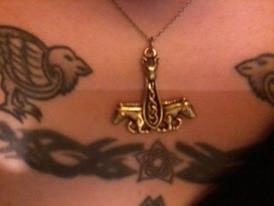
  Of course I also have a hammer that I wear as well. The Thor's Hammer appeared historically around a thousand years ago, likely to give heathens something to wear besides the Christian Cross. In modern contexts the Thor's Hammer, or Mjolnir, is a symbol of those who follow the Norse Gods, as well as symbolizing protection and fertility (Thor's Hammer, it's said, was used to bless marriages by being placed in the lap of the bride). Mine is a very modern design and was a gift. Heathens can also use the irmunsul, a Germanic world tree image, as a symbol, or the valknot a triple interlaced triangle design often associated with Odin (the word valknut means knot of the slain and since one of Odin's names was Valfadr it does seem to be a logical connection; there is a joke in modern heathenry that the valknut is the "insert spear here" symbol)
I also often wear a triskele or a tree to symbolize Irish Paganism or Druidism. Both of these are modern symbols, not having been used historically to represent a pagan faith that we know of, but are great representations of those faiths for modern practitioners. The triskele is seen in ancient Irish art, although its true origins are debated; some believe it was adapted off of the Norse valknut, while others think it is an older Celtic symbol. I also tend to favor wearing a tree emblem as it represents Druidism to me and also encompasses the concept of the bile (sacred tree or pole) and world tree. In this way the tree symbolizes both sides of my faith, the Irish and the Norse.
one of the tree pendants I sometimes wear

another tree pendant I sometimes wear 


 It's worth noting that I have gotten tattoos of the symbols I find important including the Thor's Hammer, Valknut, and Triskele, so in some ways wearing them as jewelry is redundant, but I still like the jewelry. In a world and culture were what symbols we wear around our necks are often a subtle - or sometimes not-so-subtle - way to declare our faith publically I tend to appraoch wearing mine as a matter of pride in my spirituality.
  I tend to choose the symbol I wear based on what I feel most in tune with that particular day, and my spirituality being what it is I often wear more than one symbol at a time. What sacred symbols do you wear? What makes that symbol special to you?

Wednesday, December 12, 2012

Reflections on Life and Legacy

 I awoke this past Tuesday morning from a very strange dream, most likely rooted in seeing too many previews for the new movie the Hobbit. In the dream I was traveling with a group of dwarves and an elf - picture the ones from the movie and you'll get the idea - when suddenly there was some sort of attack and everyone was knocked out. The earth began slowly growing over each inert form, seeming intent on pulling them down completely, but before the process was complete another elf appeared and woke his sleeping/enspelled kinsman. In the dream I heard a voice saying "They are never forgotten who have family to search for them, and so this one will be reborn again." Then I woke up, but with a strong feeling, not only of the importance of the ancestors to us, but of our importance to those who have passed. This was something of an epiphany for me, because I had previously tended to see my relationship with the ancestors as one where I looked to them not one where they depended on me.
    My first clear thought on waking was "If I died today how would my children remember me?". I have spent much of the day thinking about that, and about something my husband said to me in a conversation the night before; when I expressed concern about the way I decorate our house being too overtly pagan (being worried that his family and friends feel uncomfortable) he told me not to be a "closet witch". I had never thought before that I was or would be any sort of closet anything; in fact I had prided myself on how open I was with my spiritual choices. It was a wake up call to have him point out, in a supportive way, that I needed to be proud of who I am.
   So I have been thinking about all of these interconnected things, about the way our ancestors need us, about how my children think of me, and about how I change myself for other people. I truly believe these are all related thoughts, because each comes back to the idea of leaving a legacy worth being remembered for. I can even divide them up by past, present, and future - what my ancestors did to earn a place in my memory and devotions, what I am doing with my children and how they will remember it, and what I am doing and will do to shape my life according to what other people expect my life to be. What my ancestors have done cannot be undone or changed, and it does affect how I feel about them now and who I focus more on. What I do now with my own children becomes that same set-in-stone past tense, and I am suddenly aware of how precious each moment with them as they grow is. And I realized that it truly is my choice to live for my own happiness or to live to meet other's expectations. I am weaving my own legacy, strand by strand, from my choices and actions.
   When I look at the past several years I see a life out of balance. I went to college and am within 6 degrees of earning a bachelor's in psychology. I wrote six books. I started blogging and have tried to post 2 to 3 blogs per week, and now I also blog once a month for a local faith and values website, as their only neo-pagan blogger. Two years ago I was teaching at local and regional events, and this past year have been teaching locally. I've been a guest on 2 blog radio shows. I am raising two children, one with special health needs, and am married, as well as participating in or running several spiritual groups. I am clearly a very driven person and I have absolutely no idea how I find enough hours in the day to get this all done.
    But what legacy does it leave? I have no interest in being well known, only in sharing what I know with those who might gain from it, so am I achieving what I want to achieve? Am I giving my children childhood memories of me that are worth cherishing, or am I just getting through each day? Am I doing what I want to do, being who I want to be, or trying to please others? The reality is that I am pushing myself way too hard to meet the perceived needs of other people, rather than simply enjoying my life. In the past several weeks I have been struggling with some health issues that require me to rest; I am failing miserably. I no longer remember how to rest or relax, or simply not do anything. I fill every moment with something, and not always something that is good for myself or my family. And this is not the legacy I want to leave my children at all.
   I am starting, right now, to change how I do things, what I do, and to get my personal priorities in line with my actual desires. I am seeking balance, trying to remake my life - now - into what I want it to be, something that will be personally fulfilling and worthy of remembrance and honoring when I am gone. In short I am trying to live in the moment, knowing that this moment is only a breathe away from being the unchangeable past and deserves to be spent in the best possible way.
    What will your legacy be? Will your life end with satisfaction with how you lived it, or regret for focusing on the wrong things?

Friday, November 30, 2012

Karma, Wyrd, and Dán, oh my!

  It seems that many cultures have some concept relating to a person's purpose or destiny in life, and in American paganism and its many sub-branches these culture specific terms tend to get used interchangeably, often equated to the term "fate". Fate, of course, is the idea of a predestined or predetermined outcome in life which cannot be altered or affected by human action. Many Greek tragedies, such as Oedipus, are based on this idea which is personified in Greek mythology by the Moreia (the Fates) who create the "thread" of a person's fate, measure it, and cut it at death. Loving semantics as much as I do, I feel the need to point out that the terms equated to fate are not actually equivalent to each other and in fact often have very specific nuanced meanings. I thought it might be good to write about some of the most commonly used words and how I personally understand them, although I have to be clear that this is purely my own viewpoint; I am no expert. However I think even an amateur attempt at explaining the different terms could be helpful and also could provoke some great thought and discussion. I do want to stress though that this is my own understanding of the concepts, based on my research and study.
   First let's look at the most common term: karma. At this point there are two very different ways to understand karma, which may be labeled the Eastern and Western views. The term itself is from Saskrit and means "action" and is a concept found in both Hinduism and Buddhism; this is what I refer to as Eastern karma. Effectively karma is a neutral principle, the result of the sum total of our actions in this life and previous incarnations. Karma is what directs the circumstances under which we will next reincarnate. We can affect our own karma by choosing the actions we take, because all action inherently creates karma, but karma works on a cosmic scale. I like to think of (Eastern) karma as something like painting; each and every color choice and brush stroke, i.e. action, effects the end result. In contrast Western karma takes a more immediate approach, espousing the idea that karma works on a small, fast scale with the effects of our actions appearing not only within our lifetime, but also sometimes in the same day as the action. The Western view also sees karma as a moral principle, with "good" and "bad" karma based on actions. At its simplest this can be illustrated by saying if you do good, good will happen to you and if you do bad, bad will happen to you, rather like a spiritual ATM - put money in get money out, overdraw your account get charged fees. The most common view of this principle works entirely on the idea of an inherent good and bad value system to all actions, and is supported by the idea that either karma itself is a semi-sentient force or that the Gods enforce it. A less common view related this idea to energy manifestation, as a way to explain why the energy we put out returns to us. When discussing karma or when someone refers to karma it is important to know which view - Eastern or Western - they are applying because the two are very different.
   Next we have the concept of wyrd. Wyrd is an Anglo-Saxon word, corresponding to the Norse urd, and means, roughly, "to come to pass" or "becoming"; related to this is the concept of orlag, meaning "from the law".  As it was explained to me, orlag is the sum total of our past actions as well as those of our ancestors - we are born with a fixed orlag based on what has come to pass before our birth. Orlag effects all creation, including the Gods and spirits, as well as people. To quote Bauschatz: "This past includes the actions of all beings who exist within the enclosing branches of Yggdrasil: men, gods, giants, elves, etc..... it is such actions that form the layers or strata that are daily laid in the well by the speaking of the orlag. The coming into the well is orderly and ordered; events are clearly related to each other, and there is pattern and structure in their storage.” (Bauschatz, 1982). Orlag effects us because it is the base form which we move forward, but wyrd is the active principle created by us during our lives, which in turn creates orlag. Every action we take is based on our wyrd and orlag and further creates the wyrd we are then living with. Wyrd and orlag are both flexible and fixed; like water flowing in a river and the bed of the river itself. The river bed shapes where the river flows and directs the water but the water can change the shape of the river bed. So it is with wyrd - we shape our wyrd by our choices but our wyrd creates orlag which in turn directs our lives. Some people argue that orlg and wyrd are the same concept, and that may be so, I just find that it is easier to grasp them as separate but interlinked concepts. The analogy of weaving is often used to describe wyrd, and I tend to see wyrd as the weft and orlag as the warp. Freewill is an important aspect of wyrd, as we always have choices on how to act within the circumstances we find ourselves in.
   Dán is an Irish word that translates as "fate" - and also as gift, offering, craft, calling, and poem (O Donaill, 1977). It is a complex term but is often understood as the fate or destiny that a person is born with. There is a saying that goes "A man won't drown whose dán is to hang" that illustrates this idea that dán is inexorable and inescapable. This term out of all of the ones we are looking at most closely resembles the Greek idea of fate, although the Irish appear to have lacked the personification aspect of fate seen in the Greek.
  Even if we just look at the roots of each word we can see that there are differences in there meanings. Karma comes from the I-E root of kwer which means to do; wyrd comes from the root wert which means to turn or rotate; fate is from the root bha which means voice (I couldn't track down the I-E root of dán). Each root meaning connects logically to the modern meaning I think, and shows the subtle differences between the terms.
   While I can see why it is easier to use the simple equivalents when discussing the different terms I believe that it is better to understand the nuanced meanings of each term. Each one has its own layers and depth which reflect the culture and world view from which they came, and for modern pagans more can be gained by using them properly than by reducing them all to a Greek concept of fate. There is also a wealth of understanding to be gained by studying each term, in depth, individually, which I encourage people to do if the subject interests them.
  

References:
 Bauschatz, P., (1982) The Well and the Tree: World and Time in Early Germanic Culture
 O Donaill, N., (1977) Focloir Gaeilge-Bearla

Tuesday, November 27, 2012

View of Witches in Irish Folklore

  The final chapter of Kevin Danaher's book Irish Customs and Beliefs begins with an anecdote from the author's youth. He relates encountering an old woman named Nellie while on a family vacation in Clare, who, he discovers later, is known through the area for her herbal cures and propensity to curse anyone who offended her. He ends the passage by saying,
            "On the way home that day I couldn't help thinking that the old lady was very like the witch in the story books; the black cat in the hearth and the heather besom behind the door were just what a witch should have, and when I heard of her cures and curses my suspicion grew. But I soon found out that the classic figure of the witch cleaving the night air on a broomstick with her cat perched on the pillion was not recognized in local tradition. Old Nellie might be a bean feasa, skilled in cures and in divination, or even an old cailleach who stole the cows milk disguised as a hare, but not a witch." (Danaher, 1964, pages 121-122).
  This nicely illustrates a key difference between the Irish view of witches and the more well known continental one. While European lore paints a vivid picture of the witch flying through the night to unholy meetings and using her powers to torment her neighbors, wither crops, and generally spread misery, the figure of the Irish witch is markedly different. While still seen as negative and working against the community the tone of Irish witches in folklore is generally less severe. The most commonly written of way that an Irish witch might vex her neighbors is by stealing the milk from their cows or otherwise bewitching the cattle. This would be accomplished by the witch shapeshifting into the form of a hare and sneaking into the field (O hOgain, 1995). The more sinister view of witches seems to have been imported from Europe at a later time and never took the strong  hold on the country that it did elsewhere, notably in Scotland (Danaher, 1964). Rather we see the idea of two types of magic users, the bean feasa (wise woman) who helped the community with herbal remedies, divination, and advice (especially relating to the fairies), and the cailleach who was envisioned as an old woman intent on stealing the milk from the cows and more broadly a family's luck.
   Irish witches were well known to be able to take the shapes of both hares and weasels. There are several stories of farmers or hunters who are out in the early morning and spot a hare in among the cows, shoot it, and find later that a well known neighbor has been injured, having been the witch shapechanged (O hOgain, 1995; Wilde, 1991).  It is perhaps because of this association that is thought to be bad luck for a hare to cross your path (Wilde, 1991). Similarly witches could take the form of a weasel and it was thought to be bad luck to cross paths with any weasel in the morning, although it was equally bad luck to kill it and risk it's spirit seeking revenge (Wilde, 1991). It should be kept in mind though that as with so many things in Irish folklore it could always be the fairies; indeed fairies were known to take the form of hares as well, particularly white ones (O hOgain, 1995).
   Ireland had very few witch trials over the centuries and these were usually within settlements of those of non-Irish descent (Danaher, 1964). The last witch trial on record in Ireland occurred in Carrickfergus in 1711 and resulted in a conviction and a sentence of the pillory and a year in prison (Danaher, 1964). This seems to reflect the different attitude with which the Irish approached the subject, compared to the far more rabid witch-hunting that went on in Europe. Perhaps because the beliefs about witches were not as severe or perhaps because the belief in the supernatural and use of magic in folklore was so strong even after Christianization, the Irish witch never created the hysteria in Ireland that was the hallmark of Europe during this period.

References:
Danaher, K., (1964). Irish Customs and Beliefs
Wilde, L., (1991). Irish Cures and Mystic Superstitions
O hOgain, D., (1995). Irish Superstitions

Friday, November 16, 2012

Kids and Faith

There are certain questions that are commonly asked within the pagan community, and one that I see repeated at least once every few months is about raising children pagan. The exact phrasing of the question may change, but its always expressed in two core ways: should I raise my kids in my religion? and how do I teach my kids my beliefs?
   My answer to the first question is a simple yes. Of course you should raise your kids with your faith; if its important to you why wouldn't you want to share it with them? Now I'm obviously not talking about situations where there are legal reasons, such as a messy divorce, or extenuating circumstances, such as a pre-existing agreement with a non-pagan spouse, involved. But if you are actively practicing your religion and have children who you can include I really think you should, for several reasons. First of all it will create valuable family traditions around holidays that your children can cherish even if they grow up to believe something totally different. This will also create opportunities for family bonding and spending time together that, sadly, in our modern lives we often don't have much of. Secondly children generally like being included in things they know are important to you, at least in my experience. Thirdly it gives them a good understanding of your religion that will allow them later to make a decision about their own faith; related to that if you keep what you do and believe secret you may inadvertently teach them that your religion is something to be ashamed of or not good enough. Its entirely possible to raise your children in your religion without making it feel restrictive or forced, or teaching them that what you believe is the only option. I raise my daughters with my faith but they are free to go to other people's religious services or to study other options. I've never understood the idea that we should not raise our kids with our own religion because it will somehow take away their ability to choose for themselves. Finally, teaching your kids what you believe does, in theory, pass on the morals and guidelines for life that you have learned from your religion. Certainly this can be done in a secular way, but if you base your life on the 9 noble virtues, for example, why wouldn't you want your kids to have that same guideline to live with? Also if you love your religion enough to practice it, why wouldn't you want to share that with your children and give them that same opportunity to enjoy it?
    As to the second question, that one is easy - just include them in what you do and give direct answers to questions. My kindred is child-friendly and we have always had a policy that the kids are welcome to wander in and out of blot and participate if they want to. By myself I always give the girls the option of joining in with me if they want to. Rather than feeling forced or not wanting anything to do with it my kids would have me doing ritual every night if I let them talk me into it! They love hearing stories about the Gods and Goddesses as well as the other spirits and our ancestors. They enjoy celebrating our holidays. If anything I have trouble keeping up with their interest, which is bottomless. I have never gone out of my way to teach them about my faith, I just include them when I celebrate and I answer their questions. The closest I've ever come to intentionally teaching them anything religious is buying the children's books, like Kindertales, to read to them. I don't think as parents we need to try to teach it if we are giving them living examples to follow and learn from.

Tuesday, November 13, 2012

Book Review: Mysteries of Druidry

  Since yesterday was a holiday I'm doing my weekly book review today instead. I decided to review one of my favorite books on modern Druidism, Brendan Myers' "the Mysteries of Druidry". This book came out in 2006 and presents an interesting blend of modern mysticism and solid research. I like to recommend it to anyone who is interested in Druidism, especially of the Irish variety.
  The book includes a forward by Isaac Bonewits, an introduction, 7 chapters, an epilogue, notes, index, and brief about the author page. The introduction begins with an imaginative envisioning of a meeting between the young Cu Chulainn and the Morrigan, and then segues into an introduction of the concept of Celtic mysticism and modern Druidism.The chapters look at different core concepts of modern Druidism including 9 concepts that the author identifies as key to Druidism, sacred space, magic, Druidic tools, and outlines of meditations. The epilogue offers a view of what Druidism could be as a viable spiritual path.
   What I like most about the book is the author's engaging writing style and way of discussing difficult or complex subjects in accessible ways. He tackles the often problematic concepts of mysticism within Druidism in ways that are easy to follow and provide food for thought for the reader. He also provides a selection of actual ritual ideas and suggested meditations which allow a reader to experience the ideas being discussed firsthand. One of my favorite parts of the book is a section in chapter 6 that lists and describes 12 qualities of a modern Druid, which I think are well thought out and good criteria for anyone to apply who is interested in this path. The book also includes some lovely artwork and a thorough index.
  One of the only criticisms that I have with this work is that it is formatted using two columns of text on each page rather than one, and I find this a bit distracting. Otherwise I feel like the author has done a very good job of accomplishing the apparent goal of the book, to discuss mysticism in modern Druidism and also supply useful guidelines for actual practice. Mysticism is a hard topic to successfully discuss and I feel that many authors either avoid it or fail to handle it well, so it is nice to have at least one solid resource on the topic.