Search This Blog

Friday, August 29, 2014

Novels, Sequels, and Looking Back

So I'm working on the sequel to the novel I wrote last year for NaNoWriMo, and I'm having as much fun with it as I did with the first one. Something I did to help stay motivated during NaNoWriMo last year was to post word counts and little summaries of plots points or how the writing was going every day. I'm doing it again for the new book on facebook but I thought it would be fun to post the recap of all the posts from the first one, Murder Between the Worlds. It's an interesting look back at the process I went through while I was writing and also some fun hints about the way the story developed:

7,101 words- And the plot thickens.
I seriously doubt this thing will be done at 50,000 words; I'm almost 1/7th of the way to that and no where near out of the basic intro stuff...I'd guesstimate maybe 70,000 or 80,000 words in the end...

12, 623- ....and its just starting to get interesting

14,739- I have totally jacked up my protagonists day. Don't judge me! Also this book officially needs a warning for graphic content.

17,882- My protagonists day has not improved and the plot is even thicker.

19020 words- Thanks to my awesome friend Tricia for reading the draft and suggested some changes I have to add some more early stuff, but it was great criticism.

22,347- Someone's running out of time - I feel so Joss Whedon-ish

24,767- My protagonists day has improved and romance is in the air, but someone else is definitely about to end up on the wrong side of a sharp knife....

26,580 words-  6 rough chapters, 45 standard pages - plenty of room for fleshing things out later on
lots of dialogue today and some important character back-story....

30,085 words - My protagonist is about to find out that things can get a lot worse...and there's a love triangle even I wasn't expecting that is definitely going to complicate things.

33,439 words- my protagonist has made a significant breakthrough, clue-wise. Unfortunately someone close to her made the mistake of trusting the wrong person and was rewarded with a knife (or two) in the back....

37,006 words- Death has caused someone to seek solace in another's arms, which is bound to agitate my unintended love triangle. Someone else might have a chance for unexpected redemption - the question is, does he want to be redeemed?

40, 088 words- Some relationships are starting to fracture under the strain of the recent murder, while others are strengthened. My protagonist has made a major breakthrough, which is turning out to be a double edge sword, and little does she know the worst is yet to come...there's another knife waiting in the dark and this time its hitting very close to home indeed...

42,778 words- A minor clue has been slipped in with the bigger one and my protagonist is on the cusp of a major breakthrough- but the killer is about to throw out a big red herring to try to get the investigators off his trail...we'll have to see who falls for it
Also, I apparently really love writing dialogue - who knew?

45,177 words- My protagonist has realized that knowing as much as she does is putting her in danger. Those around her who need her help to solve this mystery are trying to protect her but it may not be enough.
Also there's a kelpie, because why not?

52, 228 words- my protagonist made a huge breakthrough in understanding why the killer is killing, and then made a very hard decision; she also seems to have uncovered an unexpected ability, but unless she learns how to use it, it could be more of a weakness than a strength. Unfortunately for her the killer has struck again close to home, trying to throw the investigators off his track, and he may have found some new allies.

55049 words- my protagonist has gone to the borders of Fairy seeking answers, and met the an important person there. Soon though its back to reality and there's bad news waiting for her there...

59, 281 words- my protagonist is taking the latest death very badly. The killer has set his sights on her as the biggest risk to his plans, but she may be too blinded by grief to see the danger, and the investigation is in chaos as the police argue over the false clues...

62,736 words- my protagonist has decided to be proactive and try to actively seek the killer out, rather than wait around to be killed, but this might not be the best idea. The investigators have divided and the official search for justice is stalling as everyone fights among themselves, which might also place my protagonist in more danger.

69, 736 - my protagonist found the last major clue, but no one has been able to put the cryptic pieces together yet. The other side of the love triangle chose the worst possible moment to start fighting for the girl, but he may have waited too long - when everyone's guard was down my protagonist ended up in the killer's hands. He's got a fate worse than death in store for her unless she can find a way to use her new ability to call for help, and even then - will help arrive in time?

73,387 words- denouement ~ finis opus
Sorry guys can't say anything else or I'll give away the ending
I suspect with editing and some added description and dialogue it'll pass 75,000...

83,421 - final word count


http://www.amazon.com/Murder-Between-Worlds-Novel-ebook/dp/B00MU9R106/ref=pd_rhf_gw_p_tnr_1

Thursday, August 21, 2014

The Morrigan, War, and a guest blog on Patheos

 Yesterday I wrote a guest blog for Raise the Horns on Patheos titled The Morrigan, War, & How We See Our Gods. It looks at the more difficult aspects of the Morrigan's mythology and character and why it's important, in my opinion, to face those things in her we fear or are disturbed by instead of turning away from them or trying to minimize them. It also touches on the equally challenging subject of the value of war in the quest for peace. Click over and give it a read if you're interested.  

Thursday, August 14, 2014

Frau Holda, physical worship and a story about knitting

 Recently there was an interesting blog about hands-on worship, the idea of honoring our Gods with practical physical actions. I thought it was well written and made good points but it also got me thinking about how often we may be called to do that in our own lives and how - or whether - we respond. So I wanted to share a story about my experience with Frau Holda, and the way that tangible skills are an act of worship in themselves.
   When I began honoring Frau Holda one of the first things I felt strongly was that she wanted me to learn how to knit. To me this made sense from her, as she is a Goddess associated with spinning yarn, and knitting is about as close to working with yarn as I can afford to get. But sensible or not I was dismayed. I am a domestic person in certain ways but anything relating to yarn makes me twitchy - its too tedious, too sedentary, too repetitive. I love the end results but I hate the very idea of my being the one to do it. So suffice to say that I was not thrilled to feel called to learn this skill. I dreaded it. I dragged my feet and of course found circumstances aligning so that I had ample unexpected opportunities to learn anyway. I was given all the supplies I needed, including yarn, by my grandmother who suddenly decided I was the perfect person to give her knitting paraphernalia too when her eyesight no longer let her do it herself. The same day I was at my daughters' school book fair, walking past a display, when one of those hobbies-for-dummies boxed kits suddenly fell off the table onto the floor in front of me. The topic of the kit? Knitting of course.
    I can't say I've enjoyed the process so far, and I find it challenging my weaknesses in ways that are both frustrating and irritating. I would have thought I was a patient person before starting to learn this skill. But there is undeniably something about the feel of the yarn under my fingers, the motion of my hands, the almost meditative quality of the motion, that is very powerful. I think of my grandmother knitting. I think of all the women in my family for hundreds of years that helped clothe their families with this skill. And I meditate on Frau Holda spinning, spinning, spinning....
   I haven't produced anything yet worth bragging about, but I haven't given up either. I keep trying, and honoring Frau Holda with my effort. 

Thursday, July 31, 2014

Brón Trogain 2014

  This year we are celebrating Lughnasa by it's older name of Brón Trogain. For my family it begins today, July 31st as we go out and start picking berries. Berry picking for several years has been the main activity of our holiday, the way we officially begin celebrating.
wineberries
 We have allowed large sections of our backyard to be taken over by berries, producing a thicket of thorns and fruit that provides an ample harvest. In the morning my children and I went out and began picking the ripe berries, working our way around the yard, weaving over and under the sharp branches. As we went I told them stories of the Tuatha Dé Danann and of the Gentry. I also recited this prayer:
"On Brón Trogain at the rise of the sun,
With the sun rising, warm, in the east,
I will go forth into the morning light,
And I will reap the harvest
 I have sown.
I will stand under the open sky
With the fruitful earth all around me,
I will raise my eye upwards,
I will turn on my heel quickly,
Rightway as travels the sun
From the airt of the east to the west,
From the airt of the north with motion calm
To the very core of the airt of the south.
I will give thanks to the Gods who bless me
For the growing crops of the ground,
Who give food to us and to the flocks
I will give thanks to the Gods who bless me
For the harvest that flourishes in my life
Whatever that harvest may be
And I will offer to them, sharing what I have"
my daughters pointing out a patch of Jewelweed next to a berry patch
  After we filled our bowl - with plenty left unpicked - we made offerings on our outdoor altar. My oldest daughter asked if she could have a few berries to offer to the daoine sidhe; she took a handful and went and prayed for a bit before leaving them beneath our hawthorn tree. My younger children were more interested in eating the results of our efforts themselves (I believe my son may have eaten his own weight in berries). 
 After the berry picking - and offering and eating - we had our version of athletic games, which mostly ends up being foot races, ball tossing and playing tag. The age range and needs of the children mean we have to choose things that will be more for fun than to show skill, but the intent is certainly there. We also added some prayer ribbons to our fairy tree and decorated our outdoor altar with flowers. 
   We held a small ritual to honor Macha and Nuada, with offerings of berries and of straw and prayers for blessing and protection. We also offered ghee to the ancestors, Other Crowd, and Gods in thanks for the blessings that provide the harvest we are enjoying. Divination was done with the Ogham and the message received was quert (apple).
   Thus begins our holiday....

Thursday, July 24, 2014

Celebrating Lughnasa, Together or Alone

  It is clear from my last blog that for a modern practitioner there is an abundance of material to work with in finding ways to celebrate Lughnasa. I’m going to offer several suggestions for practice that could be used for anyone with a Irish leaning, or who would like to celebrate this holy day in a Irish manner, but I leave the actual ritual up to the individual or group to design. Personally I follow a basic structure of blessing the space, invoking the ancestors, daoine sidhe, and Gods and offering to them, praying or saying something about the purpose of the ritual, making a main offering for the holiday, divination, thanking the Powers, and feasting. My own approach is Irish Reconstructionist in nature and that doubtless colors my view, but I would like to offer this to anyone of any faith who celebrates Lughnasa.
    One aspect that should be celebrated the same whether a person is solitary or in a group is food. Ideally if you grow your own fruit or grain, or have a milk cow, you could use the product of your own harvest, otherwise you should try to find high quality, local foods to use. Most Irish cookbooks should offer recipes for Barm Brac and you can substitute fresh fruits like raspberries and blackberries for the raisins and dried peel the recipe calls for. Although corn is often mentioned in relation to Lughnasa it is likely used to mean oats, and was replaced in time by potatoes as the main produce crop. It would be fine to use new world corn, especially if gluten sensitivity is an issue, if that is a local crop that is being harvested in your area at this time, or alternately to use wheat or oats to cook with. In the same way that there are many Barm Brac recipes to choose from there are innumerable porridge recipes to which fruit can be added, and fresh milk would also be appropriate. I would suggest leaving a portion of whatever is prepared out as an offering after the celebration, either to the daoine sidhe or the gods you decide to honor, or to both.
     If you are practicing with a group the group should choose a suitable place outdoors to meet, preferably either on a high place like a hilltop or mountain, or by the seashore or a river, or other place considered sacred by the group. Everyone should bring a small token dish to represent their contribution to the harvest, and if possible a fire should be kindled. The group should feel relaxed and social while setting up and getting comfortable stories should be told relating to Lughnasa; if possible music should be played or people can be encouraged to sing. It would also be alright to decorate a local stone, tree, or spring with flowers or other appropriate biodegradable decorations. At this point the group can celebrate the religious rite in whatever way they prefer, with the entire festivities dedicated to the god or gods of the rite. The food should be reheated using the fire and then shared and eaten by all, with some left as an offering as previously mentioned; this can be done during the group’s religious ritual or afterwards depending on the group. More stories can be told and music played while people socialize, and then the group should have whatever athletic games they are best able to hold. My own approach is geared towards groups with small children and involves things like foot races, contests of strength, solving puzzles, or games of skill, like tossing a bean bag through a ring with the winner receiving a special token or prize. Groups without children can of course choose to athletic games more appropriate for adults. After the athletic games if the fire has died down a bit it would also be traditional for people to jump the fire. The celebration should be planned to last for the entire day and the tone should be fun and lighthearted.
    In contrast a solitary practitioner may have to work a bit harder to include athletic aspects, or choose not to include them at all. I would suggest if you are alone that you choose a location to celebrate that will be physically challenging to get to, and include getting to and leaving the site as part of the athletic challenges of the day. You could hike to a high place or other sacred site and then, if it’s safe build a fire do so. Sitting alone you can recite stories, poetry, or sing while preparing the area; decorating a tree or other sacred object can be done alone. You can then celebrate your solitary rite as you choose, dedicating your efforts to the deity or deities you are honoring. In the same way when you bring out and eat the food you have brought be sure to leave some as an offering. You may choose to sit for a while in silence contemplating the beauty of your location or the meaning of the holy day, or you may find ways to challenge yourself (safely) to physical activities where you are. You can even jump the fire by yourself when it is low enough. Spend as much time as you would like at your ritual site, enjoying it, and then clean up and head home.
   There are many traditions associated with Lughnasa that emphasize both community and connecting to the divine. Some of these traditions pass beyond recorded history and into supposition and guesswork, but many are firmly based in folk practices that continued well into the last century. By learning about and understanding the old traditions of Lughnasa we can find new ways to incorporate them into modern pagan practices, and doing so will deepen our own spirituality.

Tuesday, July 22, 2014

Lughnasa – Festival of the Harvest

    Lughnasa is also called Lughnasadh, Lunasa, Brón Trogain, Lunsadal, Laa Luanys, Calan Awst, and Gouel an Eost, and Alexei Kondratiev conjectures that the Celts of Gaul may have called this celebration Aedrinia (Kondratiev, 1998). The many names of the holiday show it's pan-Celtic character, and demonstrate that it could be found across the Celtic world. Several of the names for the holiday are references to the beginning of autumn or of the harvest.
    The most well known Irish name of the festival, Lughnasadh or Lughnasa, can be broken down into Lugh Nasadh and translated into either Middle or Old Irish as the assembly of Lugh or the funeral assembly of Lugh. The connection to a funeral assembly undoubtedly references the belief that the celebration was originally created by the god Lugh as a memorial for his foster mother, Tailtiu, after her death, and the assembly of Lugh is thought to refer to the many athletic games and competitions associated with the harvest fairs that occurred at this time.
    The other Irish name, Brón Trogain, is usually understood to mean "Earth's sorrow", with the implication of the weight of the harvest, and is seen as a metaphor for birth (MacNeill, 1962). Brón means sorrow, grief, burden, or lamentation. Trogain not only means earth and autumn but also female raven, so it could be translated as "Sorrow of the (female) raven". Additionally Trogan is associated with childbirth through this expression "used as an imprecation [curse] troigh mhna troghuin foruibh `pangs of a woman in childbirth" (eDIL, n.d.). This name for the holiday is mentioned in the Wooing of Emer: "55. To Brón Trogaill, i.e. Lammas-day, viz., the beginning of autumn; for it is then the earth is afflicted, viz., the earth under fruit. Trogam is a name for 'earth.'" (Wooing of Emer, n.d.). MacNeill suggests, based on passages from the Acallamh na Senórach, that Brón Trogain was the older name for the holiday which only later came to be known as Lughnasa.
    Of the four fire festivals of the pagan Irish Lughnasa has some of the least mythical associations. It appears only once in the Lebor Gabala Erenn, as the date that the Fir Bolg invaded Ireland (MacNeill, 1962). It's celebration is mentioned in at least two other places: the Wooing of Emer and the Birth of Aedh Slaine. The Wooing of Emer passage has already been quoted above and refers to the holiday as the beginning of autumn and a time of fruit. The second reference says: "For these were the two principal gatherings that they had: Tara's Feast at every samhain (that being the heathens' Easter); and at each lughnasa, or' Lammas-tide,' the Convention of Taillte." (Jones, n.d.). This places Lughnasa on a level of equal importance with Samhain and describes it as a time of community gathering.
    In modern practice Lughnasa is celebrated on August 1st, however there is evidence that the date of Lughnasa would actually have represented the starting date of a series of festivals and fairs, rather than a single one day celebration with harvest fairs associated with Lughnasadh, called Oenacha which themselves may last for several days, appearing as late as August 12th (MacNeill, 1962). In modern Irish the word Lunasa means both the first of August and is the name for the entire month of August. There are some hints that the dates may be hard to pin down because they were originally based on a lunar reckoning that is now lost (MacNeill, 1962). It is generally agreed though that no harvesting should be done before the correct date, represented by Lughnasa, and that to harvest before Lughnasa is both bad luck and the sign of a bad farmer or poor housewife (Danaher, 1972). This folk belief persisted even into the 20th century and indicates the strong connection between Lughnasa and the harvest.
    There are several themes surrounding this celebration that include the mundane, the spiritual, and the blending of both. Lughnasa celebrates, at its core, the beginning of the harvest and the new abundance of food being gathered; because of this it is strongly associated with the cooking of specific foods that represented the harvest, especially porridge and bread, often with fresh seasonal fruit being incorporated (Danaher, 1972). There is also mention of cows being milked in the morning and the milk used in the feast, as well as a special type of bread being made from harvested grain and cooked with rowan or another sacred wood before being handed out by the head of the household to the family who eats it and then walks sun-wise around the cooking fire, chanting a blessing prayer (McNeill, 1959). It was understood that the period just prior to the beginning of the harvest was the leanest of the year, making the celebration of fresh fruit, vegetables, and grains all the more special to the people (MacNeill, 1962). This may also be symbolically related to another legend of Lughnasa, the battle between the god Lugh and the mysterious mythic figure of Crom Dubh. Crom Dubh means the “black bent one” and he had a special day on the last Sunday of July called Domhnach Crom Dubh and a dangerous bull bent on destruction that had to be stopped to preserve the harvest (Kondratiev, 1998). Many of the myths relating to Lugh and Crom Dubh, who is sometimes called Crom Cruach, involve Lugh battling and outwitting Crom and thus insuring the safety and bounty of the harvest; in some cases this theme is given the additional layer of the defeat, sacrifice, consumption, and then resurrection of Crom’s bull which may argue for an older element of bull sacrifice on this day (MacNeill, 1962). The Carmina Gadelica records several specific actions and charms to be done during the first harvest which expand on the importance of this turning point of the year.
    Another common practice at Lughnasa was for people to gather together outdoors at a traditional place, often with the entire community getting together, and the site chosen would not only be someplace beautiful and wild but remote enough that travelling to it would represent something of a challenge (Danaher, 1972). Other practices of Lughnasa include decorating holy wells and pillar stones on this date, and also of travelling to hill or mountaintops; all of these varied by location and indicate that while the festival itself was widespread the nature of the celebration was dependent on the area and took on a unique local flavor (MacNeill, 1962). There are references to blessing cattle on the eve of Lughnasa and of making blessing charms for the cattle and milking equipment that the blessing would remain for the year to come (McNeill, 1959). Divination was practiced, with a particular focus on the weather during the harvest and this seems to have been based on observations of the weather so far during the year and on atmospheric conditions on Lughnasa, with color and appearance of certain landmarks indicating either fair or foul weather to come (Danaher, 1972). Lughnasa was also the time in Ireland, Scotland, and the Orkneys for handfastings and weddings, or the dissolution of unions formed in the previous year (McNeill, 1959). Trial marriages of this type were used to see if the new couple was compatible; should they choose to separate after a year there was no shame in it and any child that was produced from the union would be ranked with the father’s legal heirs (McNeill, 1959). Finally Lughnasa was also well known for harvest fairs and an assortment of athletic competitions and horse races; it is important to note that the ancient fairs, or oenacha, were not occasions of commerce but of social gathering and celebration (MacNeill, 1962). Many different types of games were held, as well as competitions of agility and strength, fire leaping, and swimming races of both men and horses (Danaher, 1972). A general party atmosphere prevailed with dancing and music, storytelling, feasting, and bonfires (Evert-Hopman, 2008) Overall it can be gathered from a wide understanding of the various Lughnasa customs that this celebration was one based on the gathering together of the community to celebrate the fresh abundance of a new harvest with joy and enjoyment. People gathered to reinforce and celebrate the bonds of community through marriages and social mixing, and to strengthen and honor the bonds between the people and the spirits of the land and the gods through decorating wells and standing stones, the re-telling or re-enactment of mythological tales, acts of blessing, and ritual.
    It is unknown now exactly what pagan religious ceremonies may have been held on Lughnasa but there are several deities that we do know are associated with this holy day. The most obvious deity associated with Lughnasa is of course Lugh, who battles with Crom Dubh and is also said to have instituted the games to commemorate his foster mother. Tailtiu herself could be another deity associated with Lughnasa, as could the goddess Aine who in some mythology is connected to both a three day period during Lughnasa and to the mythic figure of Crom Dubh as his consort during this time (MacNeill, 1962). Another goddess associated with Lughnasa is Macha, one of the Morrignae, who some believe raced the king’s horses on Lughnasa; whether or not this is so there is evidence of a long standing celebration of Lughnasa at Emain Macha and the surrounding areas in Ulster (MacNeill, 1962). The harvest itself may also be connected to the Cailleach, as it was a common custom to associate the last sheaf in the field with the Cailleach; however this may be more appropriate later in the harvest season at Samhain (Danaher, 1972).
  Lughnasa has a rich history. Although in modern paganism Lughnasa is often not given great significance in Irish paganism this holiday was very important indeed and was celebrated with weeks of fairs and festival games and with special foods. It was a time of community togetherness, marriages, and reciprocity with the Gods and spirits. Studying the folk practices can give us both a greater understanding of how this holiday has been celebrated throughout the years but also give us material to work with in reconstructing modern practices.


References:
Danaher, K., (1972). The Year in Ireland; Irish calendar customs. Minneapolis: Mercier Press.
Evert-Hopman, E. (2008). a Druid's Herbal of Sacred Tree Medicine. Rochester: Destiny Books
Kondratiev, A. (1998). Apple Branch: a path to Celtic Ritual. New york: Citadel Press.
MacNeill, M. (1962). the Festival of Lughnasa. Dublin: Oxford University Press.
McNeill, F. M. (1959). the Silver Bough, volume 2: a calendar of Scottish national festivals, Candlemas to Harvest Home. Glasgow: Maclellan.
The Wooing of Emer (n.d) http://www.ucc.ie/celt/online/T301021/text056.html
Jones, M., (n.d.) The Birth of Aedh Slaine. Retrieved from http://www.maryjones.us/ctexts/aedhslaine.html

Friday, July 18, 2014

Odin By Any Other Name

   Most Gods have a variety of different epithets attached to them and some have several different names that they are known by but none may have as many as Wodan who many know as Odin*. If we look at all the different mythology and lore we find that Odin has more than 200 different names that he uses in different contexts or is known by in different places. Each of these names can be useful in helping us better understand who this enigmatic God is and I have also found it very useful to call on specific names of Odin when I need to honor or pray to different aspects of his energy. 
Shrine to Wodan
    As much as I normally loath wikipedia as a reference there is a fairly good list of Odin's names there. It's beyond the scope of this article to list all of them, but I'd like to touch on a couple at least, and why I personally choose to use them. I have several specific ones that I call on regularly, for example, but I want to be very clear that these are all names for a single god - Odin - not different Gods. The best analogy for this might be to compare it to the use of nicknames. I honor Odin as one being but I choose different heiti (bynames or nicknames) for him in different contexts.
    In the Gylfaginning and Grímnismál Odin appears as Harbard, meaning Grey beard. In this guise he is a ferryman who challenges Thor by refusing to ferry him across a river and insulting him. When I am feeling challenged by Odin this is the name I use for him. This is also the name I call on and pray to in challenging times or when I am trying to maintain my self control when being confronted by difficult people.
   In Óðins nöfn we are told that Odin is also known as Jölföðr, meaning Yule father. My family honors Odin by this name every Yule and we see him as the one who brings gifts to the children. I'm not saying Odin is Santa Claus but I will say that I see the Yule Father as one of Odin's most benevolent and kind forms, where he reinforces reciprocity by encouraging the giving of gifts and the celebration of joy and fellowship in the darkest time of the year.
   Oski, God of Wishes and things wished, is a name for Odin in the Gylfaginning and Grímnismál. I pray to him sometimes for inspiration and often for luck. He always expects a gift for a gift, in my experience, but he is generous with his giving. I have prayed and offered to Oski several times in dire financial circumstances and always had a positive outcome, although never quite in an expected form.
   In Baldr's Draumar Odin goes by the name Vegtam meaning Wanderer or Way-tamer. I call on him especially for seidhr work because I see him as Odin who travels the 9 worlds and journeys to the realm of the dead. As a seidhkona this resonates with me and I find this name for Odin works really well for me when I am doing those same things myself.
    There are a few other names I also use regularly for Odin. One from the Gylfaginning is Hrafnagud, meaning Raven God. I tend to use this one when doing divination or receiving omens more generally and almost always when I see ravens or crows I feel are associated with Odin. Another which is found in both the Gylfaginning and the Skaldaparmal is Vidrir, meaning Stormer; I tend to associate this one with Odin of the Wild Hunt. I use this name when storms pass by, when I feel the Wild Hunt near, or when I am calling on Odin in the context of the Leader of the Hunt. I use the name Hroptatyr, or Sage, from the Gylfaginning when I am honoring Odin as a wise teacher or offering to him in the context of learning. I use this one often in relation to the runes. Finally for healing work I pray to him as Veratyr, God of Men, a name from both the gylfaginning and Odins Nofn.
   This is of course only a small sample of his many names. Some other popular ones that you will often see include Har (High One), Grimnir (Hooded One), and Valfodr (Father of the Slain). Many of his names, like Bolverk (Evil Doer), relate to specific stories and it is a good idea to read those stories and understand the context of the story to understand the real meaning of the name. If you are drawn to honor Odin I highly recommend learning something about at least a few of his many names in order to better understand him.

*Although I am a polytheist I do see Odin and Wodan as the same being

Wednesday, July 16, 2014

the Story of the Sword

 "Fergus dixit ’ ‘Fó fer fris tibther manip sceó mera mórgnímo merthar airbiur mo chlaidib mache mind mosdísem calga de Galión gáir..."


"Fergus said: ‘By the point of my sword, halidom of Macha, swiftly shall we wreak vengeance on swords following on a cry (for help)..."
-Tain Bo Cuailgne

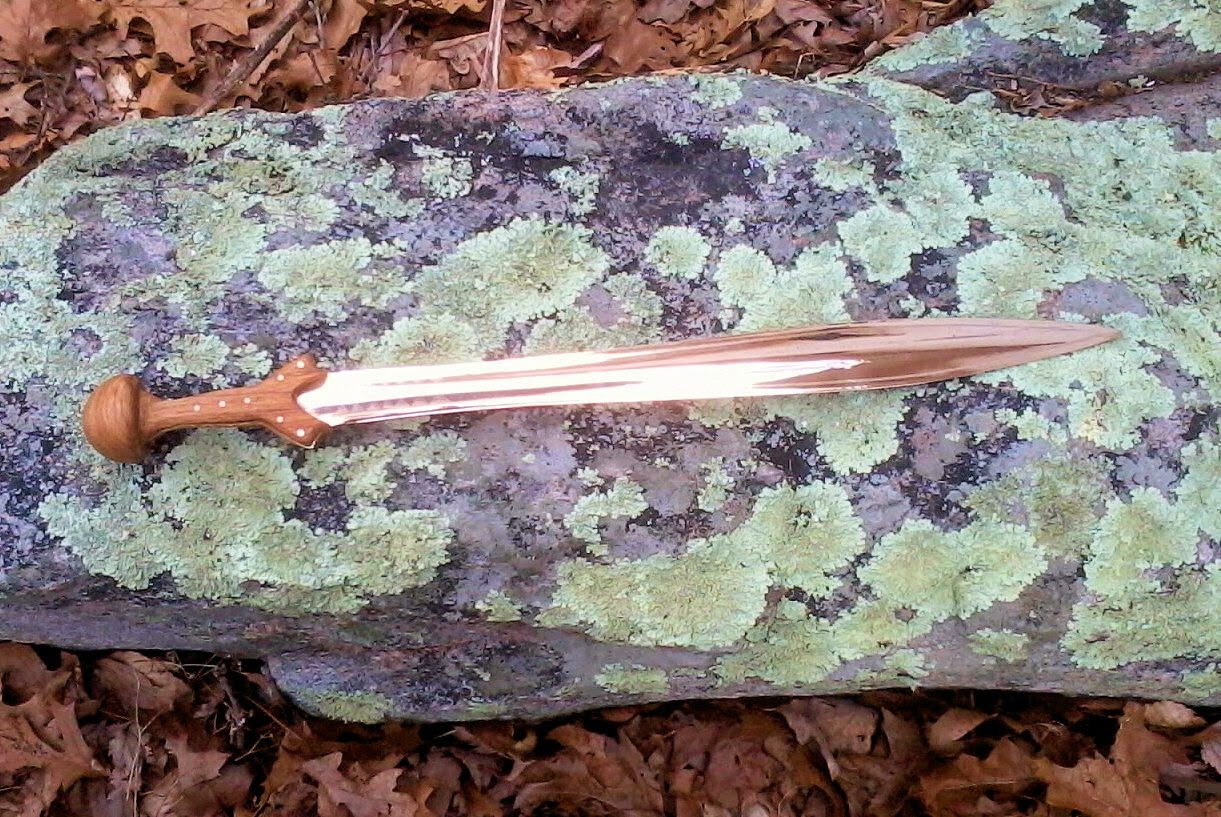
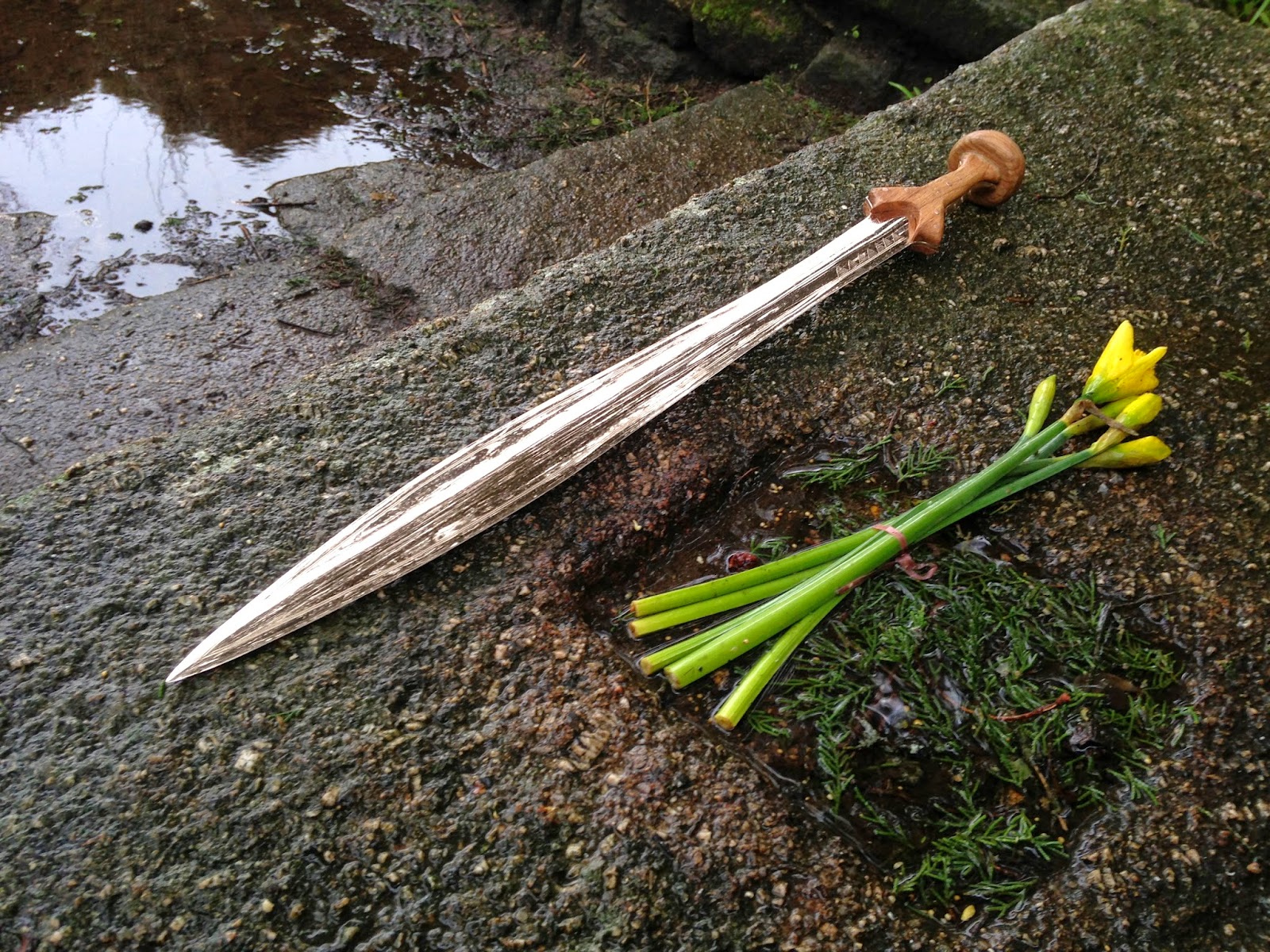
Macha's sword, my ritual blade

  I have long known that I needed to find a bronze sword for ritual use, but I never felt a huge need to get it done, just a general sense that eventually it would be needed. Late last year that sense started to become more urgent, and I realized why after finding out that I had to have a sword for a ritual I had volunteered to participate in at a retreat. I cannot work with iron so finding a bronze blade became a top priority...and so this is the story of Macha's sword and how I came into possession of it. 
   I knew that the only realistic option would be to commission the sword and several people recommended that I check out Neil Burridge's site *. His selection is good and the quality was vouched for by multiple people so I decided to email him. Because he offers replicas of blades found in Britain and I was looking for an Irish blade I requested the closest sword in style to what I wanted. I was pleasantly surprised when the sword maker contacted me and opened a dialogue offering an opportunity for me to explain exactly what I was looking for, and even more pleasantly surprised when he offered another option, a slight variation on one of his stock swords. This blade was very similar, he said, to an archaeological find from the Nooan area of Inchiquin in Ireland and he provided a link with some information. The find was associated with Lake Inchiquin, itself a place rich in fairy lore, and I was pretty quickly won over to the idea. 
  This all occurred around Imbolc this year and I knew I needed to get the blade within a few months; however I was forewarned that the actual forging might take some time. Things proceeded faster than expected though and I was contacted again on the 14th of that same month and told that the blade had been cast. That day Cornwall, where the sword was being made, was experiencing severe storms similar to what we in the United States would call a hurricane and it was in the midst of this storm and its immediate aftermath that the sword was made. It seemed entirely appropriate that this sword, intended to be dedicated to Macha, was born in a storm with all that energy around it. 
   It also came about that the sword was blessed at a holy well in Cornwall**, the Madron Well. Triple blessed, actually, being taken to a clootie tree at the site as well as laid on the stones of the well itself and dipped in the waters. I felt extremely lucky and honored that this was able to be done for the blade, but somehow also not surprised; at this point it was clear that the sword wasn't an ordinary commissioned piece. It had a spirit of its own already and a sacredness to it.
the sword at Madron Well, photo courtesy of Neil Burridge
  After being forged, hilted and blessed it was duly packaged and began its journey across the pond. This was a rather nerve wracking process, as it ended up being held in customs for several weeks, and the idea of it being lost in transit was rather appalling as it could never have truly been replaced. But finally a few days shy of the spring equinox it arrived safely. (I'll add here - if you ever order a sword from over-seas anticipate it being held in customs and be prepared for a longer wait time. Expecting the delay won't make it any less stressful, but at least you'll know it takes longer than usual)


   The blade was blessed here and dedicated to Macha on the equinox. It traveled with me to the Morrigan Retreat this past June and played its part in a ritual for Her - and truly has proved to be a sacred thing of Hers. It rests near Her statue and devotional items on my altar now, until it is needed again. 
  My next project is to make a scabbard for it, with appropriate bronze age style decorations.

* I can't recommend Neil highly enough. His work is amazing and more than worth the cost. 


** this is another story, but not properly mine to tell. I will say that the sword seems to have  a bit of its own agency...even before I got it.

Thursday, July 10, 2014

Finding Your Gods

Shrine to Artio

   If there's one thing that seems to be a constant in neopaganism and polytheism it is the rush by newcomers to the concept of multiple deities to find "their Gods". I have seen endless iterations of this over the years, of people who have converted from another faith who then immediately feel the need to declare who their Gods are. Immediately. In a way I understand why this happens - it must be unnerving if a person is going from one spirituality to another and suddenly feels adrift. For people coming from atheism or agnosticism I can see how the switch from un-belief or questioning to belief might bring with it a need for certainty about the Gods themselves. And lets not forget that ever present desire to fit in with a new peer group of people who are often vocal to varying degrees about who they worship. Don't get me wrong either, as a polytheist it is important to know who (and why, and when, and so on) you are honoring, and it is certainly a normal part of the process to try to figure out who you, as an individual, should be worshiping especially in our culture where people are not being raised with the Old Gods (or they wouldn't need to convert to begin with). The problem comes in, in my opinion, with the speed at which people feel they need to do this. I cannot tell you how many times I have seen newcomers to Celtic or Norse/Germanic paganism who have been pagan for a matter of days boldly declaring that their God or Gods or pantheon is what-have-you. And then a few days or weeks later they either boldly declare a new set of Gods as theirs or, just as often, disappear from the online community they just joined and show up in another one (what can I say - I get around) declaring with equal fervor their dedication to a wholly different set of Gods. There is, naturally, nothing wrong with starting in one place and ending up in another or feeling pulled by a different God or Gods than the ones you began with, however pantheon-hopping repeatedly as a new pagan - repeatedly and loudly - is not going to get you much respect from more established community members or help you feel more stable in your own faith. So I have a couple suggestions for new pagans just starting out who aren't sure who their Gods are or how to go about finding where they belong.

  1.    Loud proclamations are not your friend - There is no need to declare your pagan allegiance to any particular pantheon or deity as soon as you decide paganism is the spiritual path for you. You do not get bonus pagan points for announcing that you worship Goddess such-and-such or are on a specific path, especially if you aren't sure who that deity is or what that path is. In fact the quickest way to lose respect in any group is to burst in as a beginner and make a big claim while simultaneously showing that you don't know what you are talking about. Even more so if it involves spelling the name of your deity or religious path incorrectly. It is perfectly fine to be a seeker and admit you aren't sure yet what direction you are going in. 
  2.     Ask lots of questions - Questions are your friend. People in groups may not agree with each other on lots of details, but they do, in me experience, like to help new people out whenever they can. Ask questions and you can learn an enormous amount about what other people do and believe and this will help you figure out where you are going. Even disagreeing with other people is helpful in letting us find out what works for us. 
  3.     Read as much as you can - Or if reading isn't your thing find good info in other media, but the point here is be open and study different options. Feel like Irish might be your thing? Read the myths and stories. Think Norse is the way you're leaning? Grab a copy of the Eddas and get a feel for the deities. Have no idea at all where to start? Find a good general world mythology book and read a selection of stories. Many people start with their own ancestral cultures or homeland, but sometimes you might find that nothing seems to be clicking, so keep an open mind and read the mythology. The myths are how we get to know the Gods, the first step in understanding who they are. 
  4.    Experiment - If you feel drawn to a God, Gods or pantheon then start by dipping your toe in the water so to speak. Read as much as you can and find ways that you are comfortable reaching out to form a connection to those Gods. Make offerings, use guided meditations, honor them in an appropriate context at a holiday - whatever works for you on the religious path you're on. But the point is don't rush into declaring a commitment to any deity, rather let yourself get to know them first, and let them get to know you. Sometimes we like a God very much on paper, but find that in practice they don't gel well with us at all, or don't respond, or just don't feel right. 
  5.    Be active in other ways - While you are sorting out which Gods you will worship you can be actively honoring your ancestors and the spirits of the land. You can be finding out which spiritual path works best for you. Whatever Gods you decide on (or who decide on you) your ancestors and land spirits will be the same and are important too - so use the time to focus on those aspects. 
  6.    Most importantly take your time - There is no rush. There is no pressure. You are not more pagan if you are committed to a pantheon or dedicated to a deity, and you aren't less pagan if you are still searching for your place. Don't feel like you have to instantly choose and lock yourself into a specific thing. While it can be frustrating to be a seeker it is also a wonderful opportunity to explore all of your options. Enjoy the experience for what it is rather than rushing to get to the destination. Let the Gods come to you - or find your way to them - slowly over time. Being a polytheist is about having a relationship with the Gods you honor, built on reciprocity, respect, and a sense of connection, and that doesn't happen - usually - overnight. It's a process. 


Monday, June 30, 2014

"I am Guarding Your Death"

   Saturday morning I was home, getting ready to head over to my friend's store when my mother called me. She and my oldest daughter had gone over to my grandmother's apartment, a few minutes drive from my house, to check on her. My mother's voice on the phone was small and hesitant, "Morgan, your grandmother's died. What do I do?"
   I took a deep breath and I told her to call the police department - I gave her the number - and assured her I'd be right there myself. Leaving my younger children with my friend who had come to watch them while I went out anyway, I drove over and found my mother and daughter standing on the expanse of grass at the senior housing complex, crying. The police were on the way. My mother needed my grandmother's address book to begin calling people to let everyone know what had happened, which is how my mother handles these things. I went in to the apartment to get it. I knelt down next to my grandmother and prayed, to her god and to mine, to our ancestors - especially my grandfather, great-grandfather, and father (her son-in-law).
   The fire department came. Paramedics came. Police came. Everyone was wonderful and kind. My daughter sat out on a bench, in the shade, drinking a soda that a neighbor had given her, next to my mother who clung to the phone like a lifeline. I tried to deal with all of the official things as best I could. The fire department left. The paramedics left. The police explained that the funeral home was tied up at a service and would be at least an hour, so we waited together. The police have to stay with the body until its removed; we didn't have to stay but chose to. I was thinking of the old practice of wakes, of staying with the body and of my father, who had served in Vietnam, telling me that you always stayed with people.
   We watched three turkey vultures circle overhead. An osprey with a fish in its talons flew directly over my grandmother's apartment, earning an exclamation of joy even through my daughter's tears. Later a hawk circled lazily through the dazzling blue sky. Dragonflies darted around and a variety of songbirds flitted in to the feeders set up in front of homes. Neighbors came one at a time to ask what was going on, offering support and cold drinks. We talked with the police officer about my grandmother, about how at 96 she still babysat my older daughters (10 and 6). Still lived on her own, still cooked for herself, still did the crossword everyday.
   Finally the men from the funeral home arrived, not in a hearse but in a nondescript grey van. I was disappointed by that; my grandmother deserved the pomp and style of a real hearse. My mother and daughter took a walk to avoid seeing her being taken out - I stayed. I stood, solemn, and prayed as the gurney went in and came out again with its burden. I tried praying to Manannan to help her soul find its way, but my head didn't want to cooperate. I kept thinking over and over of the line from the Tain Bo Regamna where the Morrigan tells Cu Chulain she is guarding his death, and then the way in the Aided Conculaind that she perches on his shoulder after he dies. I felt very much like I was guarding my grandmother's death. I found myself praying to Badb instead, to help my grandmother find her way, to carry her soul to the Otherworld. Somewhere in the woods behind me crows began calling, their voices a rough caw-caw as the van doors closed.
   This is only the beginning; we must get her apartment cleared out and her possessions dispersed. I must add her picture to my ancestor altar, a bittersweet prospect. She is to be cremated and the ashes divided - a task assigned to me - into three portions. The last is a daunting prospect to consider, but I will do what needs to be done as respectfully as I can.
   My grandmother was an amazing and wonderful person. I grew up with her as a part of my life and I have many happy memories. I am also glad that she was a significant part of my children's lives. I will miss her cooking corned beef and cabbage on Saint Patrick's Day. I will miss watching White Christmas and Miracle on 34th Street with her every year. I will miss her forcing cookies and ice cream on me every time I visited. I will miss taking drives with her along the coast or just sitting in her apartment talking. I will miss the unconditional love. I will miss her, even knowing that she will never really be gone.
   Ochón! Ochón! Tá brón orm.

Thursday, June 26, 2014

A Dream of Lughnasa

   I had a strange dream last night about a ritual at Lughnasa. In the dream the people had gathered to honor Macha and Nuada at the harvest, which they were calling Brón Trogain. Everyone had met at a recently harvested field, the earth exposed with only a stubble of stems left jutting up in ragged rows. Two horses had been harnessed together with someone walking behind them, driving them. Two older girls walked in front and to each side of the horses tossing handfuls of straw in their path. The horses were driven over the straw as someone prayed to Macha to bless the earth and Nuada to ward it. I do not remember all the words of the dream prayer, only this part - "...walking, may your steps be sacred steps, walking, may Macha, raven of fierceness, bless this earth, walking, may Nuada, hound of battle, ward what we hold dear...".

  When I woke up I remembered the imagery and feeling of the dream quite vividly. I thought it was very odd because, although I know Brón Trogain is an alternate name for Lughnasa* it's not one I ever use. Macha is tied to Lughnasa by the Aontaí (harvest fairs) at Emain Macha, but we don't have, as far as I know, any existing rituals or even hints of rituals for her at that time. Also although there were traditions in the spring of leading horses over fresh planted fields to make the crops grow better (O hOgain, Lore of Ireland mentions that) I don't know of any such rituals in the autumn.
   I decided to do some research into the different parts of the dream and as expected didn't find anything relating to the ritual itself. Weirdly I did find a study showing the agricultural benefits of covering fields in cut straw over the winter, but I don't believe this was an Irish practice in antiquity. Macha is connected to horses, so the idea of the horses as a blessing agent had a certain logic to it. What I found most interesting though was looking up Brón Trogain in Old Irish. Usually the name of the holiday is translated as "sorrow of the earth" because of the phrase given in the Wooing of Emer passage and it is firmly connected to the beginning of autumn and Lughnasa. I decided to look at what the words themselves actually meant to see if that could offer any insight. Brón means sorrow, grief, burden, or lamentation. Trogain not only means earth and autumn but also female raven, so it could be translated as "Sorrow of the (female) raven". Macha, of course, as one of the Morrigans is associated with both the hooded crow and the raven, forms that she was believed to take. Additionally Trogan is associated with childbirth through this expression "used as an imprecation [curse] troigh mhna troghuin foruibh `pangs of a woman in childbirth" (eDIL, n.d.). I have long held the imbas that it was at a Lughnasa aonach that Macha was forced to race the king's horses and gave birth to her twins, and cursed the men of Ulster, so the odd linguistic connections between the name Brón Trogain for the holiday and the translation of "sorrow of the raven", along with the connection of the word trogain, possibly, with a curse relating to women in childbirth seems far from coincidental to me.
   I still don't fully understand what this dream meant or why I had it. But I think I will be calling the holiday I celebrate on August 1st Brón Trogain from now on....

*From the Wooing of Emer:
55. To Brón Trogaill, i.e. Lammas-day, viz., the beginning of autumn; for it is then the earth is afflicted, viz., the earth under fruit. Trogam is a name for 'earth.'’

Tuesday, June 10, 2014

The Morrigan's Call: A Retreat Dedicated to the Great Queen

    I spent the last weekend at Temenos retreat center in Massachusetts, participating in a spiritual retreat dedicated to the Morrigan. The retreat itself ran from Friday afternoon through Sunday afternoon, but a lot was packed into that short amount of time. There were workshops, rituals each day, and a concert by Jenna Greene. We set up a temple in a screened in space at the top of a hill, and our temple had altars for an Dagda, Badb, Macha, Anu, Nuada, and the land spirits, as well as a large main Morrigu altar.
the main Morrigan altar

FRIDAY:
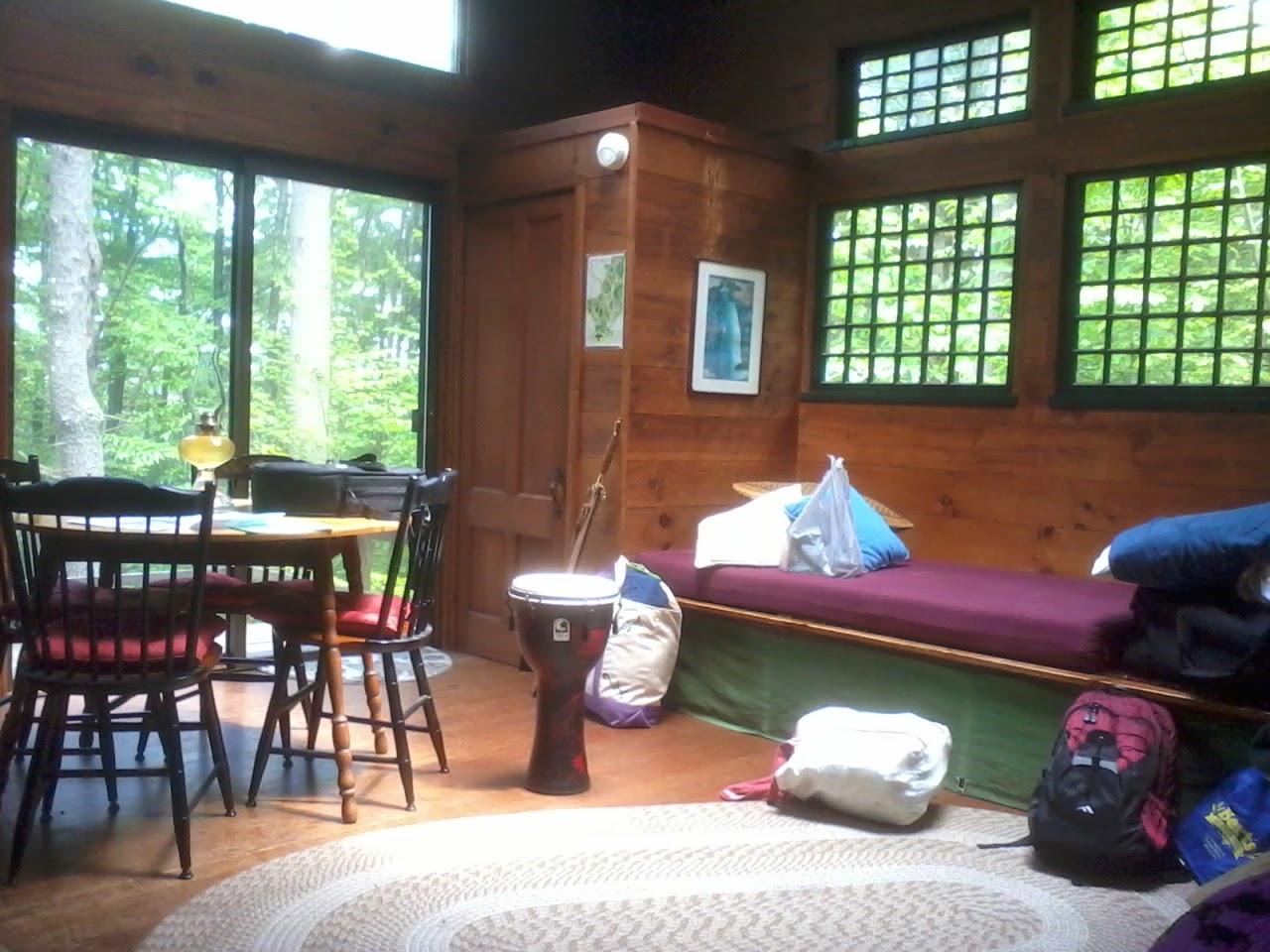
   I traveled up with my friend Melody. We arrived Friday afternoon and were directed to our cabin by Stephanie, who was organizing things. Temenos is off the grid so there is no cell phone reception, no electricity, and no plumbing. Our cabin, which we shared with two other amazing women, was beautiful; I could easily see myself living in that cabin year round. There was a kerosene lamp for light at night and a woodstove for heat, although we never needed to use the latter.

our cabin
 After unpacking and a quick side trip to the temple space to drop off some altar items, we hiked the half mile or so to the main lodge  over the dirt trail with its roots and stones and undulating rise and fall, watching carefully to avoid stepping on the little salamanders we'd been warned would be out and about. The main lodge was like a large version of our cabin but with a kitchen and limited running water; the water at Temenos is mineral water laced with iron, magnesium, and sulfur so there was also an abundance of bottled water around. Most people were staying at the lodge so on Friday afternoon it was a hub of activity as people arrived and settled in.
   Eventually, when it seemed that everyone who was coming had gotten there, we all processed up to the temple space - and I mean up, up a winding, steep, rocky path that I jokingly called a goat trail - to bless the space and invite in the different Powers. Blessing the space was a special experience, and I am glad I got to be part of it. The altars were a joint effort, created by people who brought different items to add, but the end result was cohesive and beautiful.
   At this point, if memory serves there was a break for dinner and then those of us participating in the first night's ritual headed down to the ritual space to get ready. Stephanie and Mayra Rickey had designed the rituals together and several of us had volunteered to help out by taking parts in them. This first one invoked Badb as the Washer at the Ford and was focused on cleansing and releasing the past. I cannot possibly do justice to the ritual by describing it in words; it was intensely moving and powerful and I truly believe that She was present with us and that we each got what we needed from the experience.
  After ritual, as the moon rose and the sunlight faded to darkness, we made our way back to the lodge and Stephanie and I taught our workshops. Her's was an introduction to the Morrigan and mine was about the Morrigan in the Invasion myths and what we could learn about Them and how They related to other Gods in those stories.

SATURDAY:
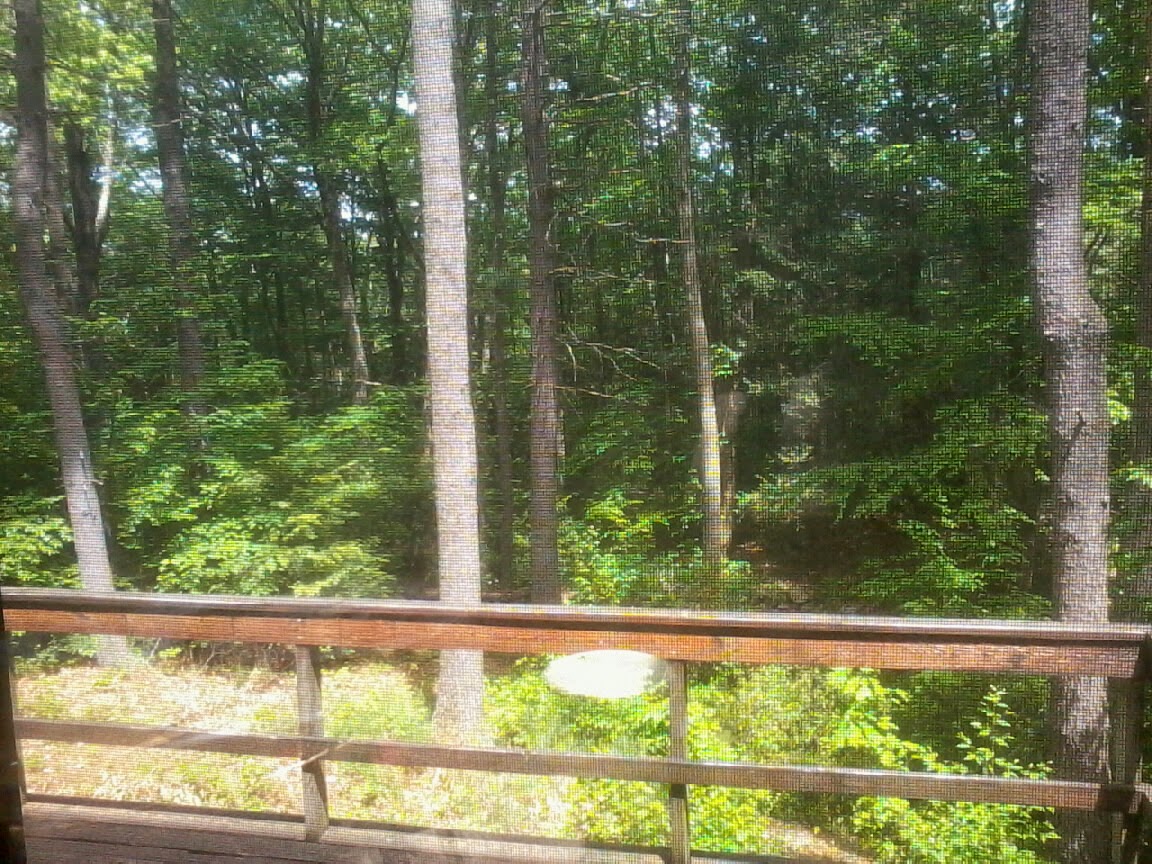
    Saturday morning started early, as we all woke up just after 6 a.m.; nonetheless we were slow getting going out of the cabin. The four of us spent a couple hours talking, reflecting on the first day, getting to know each other, and generally socializing in the cabin.
the view from our cabin
As the sun climbed higher though I finally had to excuse myself to go to the temple for my morning devotionals before breakfast. Morning devotional prayers are a daily practice I find deeply fulfilling and which I always find some way to do, although its much better to have a dedicated temple space to do them in. I went up, prayed, introduced myself to the local land spirits and daoine sidhe before heading down to the lodge looking for something to eat. The atmosphere in the lodge was open and friendly, with people hanging out and chatting in small groups. I made my way to the kitchen where one of my cabin-mates, the amazing Natalie, was cooking and I quickly acquired some pancakes. It was wonderful to stand and eat and get to know my fellow retreat members, especially talking with people that were from very different places that I had an unbelievable amount in common with.
   There were some great workshops Saturday, including a class by Stephanie on Babd, one by Ed Rickey on the warrior mindset, and one by Michelle Skye on connecting to Macha. All of them provided insight and moments to connect to the Goddess in profound ways. I taught one on honoring the Morrigan in difficult times as well. And in between there was lunch and labyrinth walking and more socializing.
   The highlight of Saturday for me was a ritual devoted to Macha, who of course I am dedicated to. The ritual was designed as a challenge, to confront people and ask them what was worth fighting for. I had the role of Macha of the Battlefield and the job of challenging each participant with my sword during the center of the ritual. I consider it a very great honor to have been able to do this as part of my service to Her and I hope that I did that job well. The ritual itself I cannot describe, but I will say that it was one of the most intensely spiritual experiences of my life.
  Afterwards the group headed back to the lodge for dinner and I and a couple others went up to the temple space. Honoring Macha is an honor to do, but it is not always easy nor simple, and certainly not always what I expect it to be. I let go of one of my greatest fears this weekend and embraced an aspect of service I have always balked at doing, always pulled back from. I let go of my fear and faced my own challenge, my own question of what was worth fighting for, and set my feet on a path that I cannot turn back from now. Because there is dedication in word and there is dedication in deed...
    After temple we went down to the lodge with everyone else and ate and enjoyed Jenna Greene's concert. I have heard Jenna many times but it is always a treat to listen to her play her harp and sing, especially this time with Brian Duguay joining in - they duet beautifully. It seemed like such a perfect ending to a day that was both intense and moving, although in fairness my day ended not with gentle music but with a rather amusing trek through the dark, following a flashlight beam and my intrepid cabin-mate Ivy with my other cabin-mates trailing behind. There was a certain symmetry in the day ending as it did, with music and song and fellowship followed by a challenging journey on a rough and unpredictable path through the tenebrous woods.

SUNDAY:
   The morning of the final day dawned bright and hot. Morning devotionals were followed by breakfast and socializing, very much like the day before, the routine already feeling comfortable and normal. It quickly became clear that the original schedule for the day was going to have to be rearranged to accommodate several unplanned for situations that had arisen, but the entire group rolled with it in a marvelously convivial fashion. We moved the final ritual, a blessing dedicated to Anu, up and shifted the workshops back, moved the location of the ritual closer to the lodge to accommodate some mobility issues and worked in a small mini-ritual before hand to include a couple people who had missed the first two rituals but wanted to come to the final one. I reprised my role as Macha in the mini-ritual and participated in the Anu ritual as Anu of the sidhe, handing out the blessed tokens. The energy of this final ritual was calm and solid - I felt like a standing stone through most of it - and entirely perfect to end the retreat with.
  After the final ritual we had a raffle to raise money for the Wounded Warrior Project, with lots of great items going to support the cause. Then Michelle did a workshop on bird omens, I taught one on Morrigan and the Fair Folk, which ended up more as a class on the Fair Folk with some discussion of how that relates to the Irish Gods (and apologies for my atrocious accent in Irish to the lovely girl from Roscommon), and Natalie did a crafting workshop. And then it was a rush to pack and head off the site to get home....

Temenos

    People came to this retreat from as far away as Canada and Florida, from California and Virginia. People came representing many different pagan paths and belief systems. Women and men, old and young, different ethnic and socioeconomic backgrounds, different education and life experience backgrounds, different beliefs and approaches - a diverse group of people, all coming together for one purpose, to honor the Great Queen. Without melodrama, without interpersonal conflict or ego, without tension between the many, many different people's differences. We came together to honor Her, and we did; in word, and song, in ritual, and prayer, in communion with each other and by sharing our experiences and insights with each other. And it was an awesome and amazing thing to experience.   

Thursday, June 5, 2014

Random Morrigan Shenanigans

 Recently a new book was released: By Blood, Bone, and Blade, a tribute to the Morrigan. This is an interesting work with an assortment of material from many different contributors and like all anthologies some of the material is really good and some is less so. I personally have an essay and several prayers in the book.
  On another Morrigan related note I will be at a Morrigan Retreat in Massachusetts this weekend teaching workshops, helping with rituals, and generally honoring the Great Queens. I'm excited for this opportunity to honor Her/Them and to spend time with other people who honor Her. My workshops look at the Morrignae in the Lebor Gabala Erenn and what that tells us about Them, the Morrigan as a goddess for difficult times, and the Morrigan in relation to the daoine sidhe.
  When I get back I'll share my experiences here.


Friday, May 30, 2014

Ethics of Divination

  In most modern pagan paths divination plays an important role. This is true in modern witchcraft and in Druidism, where divination might be used in ritual to predict a group's immediate future or to tell if offerings were accepted. Divination in witchcraft might be used before or after spellwork or more broadly to help a person find guidance or communicate with the Gods and spirits. In Heathenry we see divination used sometimes at baby blessings or namings, where a rune might be drawn to predict the child's luck, or as part of some rituals by adult participants for a similar reason. Besides ritual applications divination is also used more broadly by people seeking answers and looking for insight.

   Although not every Druid, witch, or Heathen uses divination, for many it can be a central tool for the practice of their faith. Divination then is an important thing to consider within a spiritual context and looking at it in this context raises important ethical questions. As a diviner what responsibility do we have to relay the messages we receive in an ethical manner, knowing that divination is an often imprecise and vague art?
   The first way that this can come up is when we are taking omens in ritual and the omen appears as a negative one. If it applies to a person care must be taken in how the omen is relayed so that it doesn't seem overwhelmingly bad, but at the same time we don't want to soft pedal the message so much that the meaning is lost. I've seen both extremes happen, once where a negative omen was given very bluntly in a way that frightened some people, and another time where a negative omen was actually rejected and a second omen taken so that the message would be better. Neither of these is constructive; rather I think we have an obligation to say what we see in a neutral way that shares the content but without passing on a sense of judgment of good or bad. This can of course be challenging if the omen itself is very negative, but even in that case the response can include further divination to find out if anything can be done to mitigate the situation. This is where interpreting the omen comes in and the interpretation should rely on both intuition and an ability to craft the message in a constructive way. Even a bad omen serves a purpose and should be interpreted and considered, rather than ignored or rejected.
    The second way I think that ethics can come into play is when we are doing more general divination and the reading is showing information that is important but will also certainly negatively impact the person hearing it. I have read tarot semi-professionally for over 10 years, and runes for more than 5 and I have had an amazing array of things come up in readings. I've had people ask about infidelity, parentage of children, pregnancy, and serious illnesses - and I've had all of these things come up for people who were not asking about them and had no idea there might be any such problems. What is the ethical thing to do? Do we tell a person a what we see when it might motivate a divorce or initiate an affair? My own approach to this, as with omens, is a middle road. I emphasize the uncertain, shifting nature of any divination tool and the need to really think about and process any information. I talk about possibilities and potentials rather than certainties, but I don't change the actual message of the divination tool, be it cards or runes.
   In the same way we should be cautious about over-emphasizing the positive in a reading. Making a moderately good reading into an extremely great one is not only unfair because it distorts the message but may also mislead the person into choosing an option they mistakenly believe is much better than it really is. Just as with negative messages, positive messages should be relayed in a straightforward manner that emphasizes the changeable nature of all divination.
   In my experience people will ultimately only listen to what they want to hear, no matter what you say or how you say it. But to be an ethical Seer or diviner is important and we should strive to be honorable in how we read for others. Being honorable means being honest and presenting the message without distortion, but also being clear that no message is written in stone. We should be sensitive to the feelings of the person or people we are reading for without letting ourselves be influenced to tell them what they want to hear. In the end we should approach reading for others as we would want someone else to read for us.

Tuesday, May 27, 2014

Wellspring 2014

 I returned home yesterday from my first national festival, Wellspring, an event put on by ADF.  This is ADF's 30th year, and although I've been a member since 2001 I've never attended an ADF gathering before. This year though I was asked if I'd be interested in doing a few workshops at Wellspring and after discussing the logistics with my Kindred sister, decided that it would be fun to go and bring the kids. I put in proposals for a selection of workshops and was set to do three: honoring the Other Crowd as a modern pagan, living Celtic Reconstructionism, and the Hidden Folk in Norse and Irish culture.
Thor shrine in the Runestead

   There was some point then were putting 5 children ages 10 through 1 in a car together for close to 9 hours was a good idea. In retrospect I don't know when that point was, but we did it, and after an epic drive through the night to avoid holiday traffic we arrived at Brushwood. We chose a campsite located strategically close to the bathrooms (5 small children, remember?) and also on the fringe where crying baby at 6 am was less likely to bother people.
  There were a couple downsides to the weekend. We had been warned to be prepared for cold weather; we failed to anticipate it getting down to the mid-40's (Fahrenheit) at night and so did not have enough blankets. The kids were okay, of course, but the adults did not sleep well - and teaching workshops on little sleep makes for interesting times. I may have done an impression of Fonzie from Happy Days in one workshop. We also forgot to pack our bottled water so its safe to say dehydration was an issue.
  That aside I can honestly say Wellspring was an amazing experience. Brushwood itself is a wonderful place with a permanent nemeton and runestead where people can go to worship. I attended a moving Morrigu devotional at the nemeton the first day; during a portion of the ceremony where personal omens were being taken the temperature suddenly plunged so that our breath was a visible plume in the air and then just as suddenly warmed again. Every morning we would walk to these sacred places with the children to do our devotional prayers, which was powerful not only for my friend and I but also for the children.
Nemeton
My oldest daughter especially found the experience to be profound, as there was a small shrine to Brighid she went and prayed at every morning. She feels a strong connection to Brighid, which was made stronger by this devotional practice. I suspect she's trying to think of how to make something like this at home now.
Brighid's shrine
 Speaking of children - Wellspring had a great kids program with lots of fun activities. We'd been a little worried about keeping the kids occupied and happy, but they all enjoyed themselves - enough that they are asking to go back.
   There was a potluck dinner the second night we were there and I have to say I have never had so much fun at a potluck before, even if I was wrestling tired kids most of the time. The food was great, the company was great - Stone Creed Grove kindly invited our rolling circus to sit with them - and the atmosphere overall was convivial. And after dinner the Dragon Ritual Drummers performed, which was amazing to listen to - even from a quarter mile away, in a tent, with a sleeping infant.
  I saw an old friend and was able to spend a little bit of time with her, met several people in real life that I had previously only known online, and made several new friends over the course of the weekend. I think my workshops went well, and I enjoyed the ritual I was able to attend. I certainly wish I'd had more time to spend talking with people but overall I think Wellspring was a successful experience for us, and I came home feeling physically tired but spiritually revived.

Thursday, May 8, 2014

Creating a German Heathen Cycle of Holidays

  One of my first steps in approaching Germanic Heathenry has been to look at what holidays to celebrate. Up until now I've divided my holidays between the Norse and Irish, with the solar holidays - the equinoxes and solstices - being Norse, so this represents an entirely new approach. I believe though that its important to have a solid idea of what is being celebrated, when, and why because it not only connects us to the cycle of the year but also creates a pattern of offerings and reciprocity with the gods and spirits. 
   If the year is divided into two halves, as Grimm describes, and May begins Summer then we may surmise that November begins winter; this lines up perfectly with my own regional environment so I am comfortable going with it. For my purposes then I have Summer Finding in May and Winter Finding in November, representing the shift between the two seasons; in each case the season that is ending would symbolically be defeated by the one that is beginning. Both also have different associations with the Wild Hunt. So we have just celebrated Summer Finding, Sommer Entdeckung, representing the beginning of summer and defeat of winter. 
   After summer begins we have the summer solstice, Mittesommer or Midsummer, when we honor Frau Sonne at the height of her power. Much like May Day this holiday was traditionally associated with Maypole dancing and revelry.
   We know from Grimm that the elves - alfar in Old Norse or German alpen or elben - were given offerings ceremonially in what he equates to the historic Norse alfablots. We just don't know if this was done at specific times of year, or when there was a need, or regularly. I decided to place this celebration at the beginning of the harvest season because the elves were associated with luck, health, and prosperity - all things that also go well with the symbolism of the harvest. I'll call it Elben Segen, or Elf Blessing. 
    I also wanted to include a celebration that focused just on remembering and honoring the ancestors; autumn seemed like the best time for that, but there was other symbolism already associated with the November 1st holiday, Winter Finding as I call it, that I felt detracted from the focus I was looking for. So on the fall equinox I'll celebrate Erntedankfest - Harvest Festival, Thanksgiving - which like the secular American Thanksgiving will emphasize family and harvest foods, but also include a ritual to honor the ancestors.
  Winter Entdeckung, Winter Finding, on November 1st will celebrate the passage of summer and return of winter. Wodan and Frau Holda will be honored, symbolizing the return of the Wild Hunt. 
  Julfest is a 12 day celebration running from approximately December 20th through January 1st. I've blogged about my yule celebrations before here. This year I will of course be looking at how to shift to a more Germanic approach, like including Holle Nacht, but I think many of the traditions will probably be fairly similar. 
   After Julfest, at the beginning of February, I want to keep the modern Heathen celebration of disirblot, but call it Idisi Segen, or Idisi Blessing. The Idisi are protective ancestral spirits, women who have died but continue to watch over the family line. Its important to properly honor the Idisi and I think its very appropriate to have a holiday just for them. 
   In March, at the spring equinox, I celebrate Ostara in honor of the German goddess of spring. She's an obscure one, but there is enough evidence of her to convince me and I think its important to honor her as the initial force of growth and renewal in the land. I have also previously honored Artio, a Germano-Gaulish goddess at this time. 
   And that brings us back to May Day - Sommer Entdeckung, Walpurgisnacht - which I just wrote about in depth and celebrated. 
    So from what I've gleaned from Grimm and incorporated from modern Heathenry I'm looking at:
Sommer Entdeckung - Summer Finding - May 1st - Frau Holda
Mittesommer - Midusmmer, June - Frau Sonne
Elben Segen - Elf-blessing, aka Alfarblot, august 1st - the Elben
Erntedankfest - Harvest Festival - September - honoring the ancestors
Winter Entdeckung - Winter Finding - November 1st - Wodan and Frau Holda
Julfest - aka yule, the night of December 20th through morning of January 1st - many different Gods and spirits
Idisi Segen - Idisi blessing, aka Disirblot, February 1st - the Idisi
Ostara - March, welcoming spring - Ostara


Tuesday, May 6, 2014

Sommer Entdeckung - My Family's First Walburgisnacht

   The evening of this past April 30th my family celebrated our first German-oriented May Day. It has been an interesting experience so far shifting focus with the children; their questions are pushing me to clarify and have an understanding of what I am doing that I probably wouldn't worry about otherwise. 
    We dedicated our celebration to Frau Holda and to welcoming back the summer. We invited in our ancestors, the friendly Huldufolk, and Frau Holda. We sang "Winter out, summer in" and I told the children about how we were at a turning point in the year, shifting from winter to summer. The children were curious about the ideas of summer and winter fighting each other and expressed hope that now our weather would finally turn. I pointed out that our local signs of spring/summer finally arriving included the forsythia and azaleas blooming.  We also talked about some of the history of the holiday and its association with witches. We made offerings of cedar to the landspirits, burning them on our altar, and offered bread to our ancestors. For Holda we offered flax seed, because its said that she brought flax to people. Finally we prepared a slice of oatmeal bread with butter and honey as an offering for the Windhund* and left it outside. 
    I had planned to include two things that we ended up not doing because of a cold steady rain: making a May Bush and ritually "drowning" winter. The first is actually a tradition shared by the Irish and one that the children and I have done before - it's always fun. We take a branch from a tree and set it up by the door and then decorate it with yellow ribbons and flowers. The second I read about in Grimm and I loved the symbolism; an effigy of Death, representing winter, is created and then ceremonially drowned in a lake or other body of water. My oldest daughter made a paper figure representing winter and we planned to drowned it in the swamp behind our house. After death/winter is banished we would have sung:
"Wir haben den Tod hinausgetrieben,
den lieben Sommer bringen wir wieder,
den Summer und den Meien
mit blümlein mancherleien"

 (We have driven out Death
  brought back the dear summer
  the summer and the May
  with little flowers of many kinds)
   All of this had to be saved for another day, probably next weekend, which will put it close to the end of the 12 day Wonnetdanz of Urgalaawe. I suppose that's fitting enough.  
  After the children went to bed I did a small personal rite to Holda on my own, committing to one year of honoring her and studying German Heathenry. It seemed fitting to do from one May Day to another. 
Duncan Royale Frau Holda statue


*the Windhund is a hound of the Wild Hunt left behind during the summer who may bring luck, prosperity, and protect from bad weather